


Introduction
The discourse surrounding Hindu saints in India often includes narratives of criticism and opposition, particularly from groups generally identified as the “Left ecosystem” (comprising certain political parties, media outlets, and intellectuals). Understanding the reasons behind this perceived targeting requires examining the ideological underpinnings and societal roles of both the Hindu monastic order and the Left-leaning ideologies in the Indian context.
The Invisible Enemy: Anatomy of the Ecosystem
In the intricate tapestry of Indian democracy, a chilling narrative has emerged, suggesting that while the government may change at the ballot box, the underlying “System” remains captured by forces hostile to the civilization’s core identity. As articulated in popular discourse, there is a prevailing sentiment among the entrenched elite: “The government might be theirs, but the system is still ours”. This “system,” often described as an ecosystem or a “deep state,” is not merely a bureaucratic machine but a coordinated network of journalists, lawyers, activists, and intellectuals who operate with a singular, often anti-Hindu, agenda.
Former General Bipin Rawat once famously remarked that India faces “2.5 enemies”—China, Pakistan, and the “0.5” enemy residing within the country’s own borders. This internal front is comprised of individuals who, while living in India and enjoying its resources, run propaganda campaigns that systematically undermine the nation’s cultural and spiritual foundations. This ecosystem is pervasive, embedding itself in cinema, literature, sports, and, most critically, the judiciary and media, creating a formidable barrier against any attempt to revive or protect Sanatan Dharma.
The primary target of this ecosystem is the Hindu saint—the custodian of India’s civilizational heritage. The logic behind this targeting is strategic. As noted by observers, the Leftist establishment identifies Hindu culture and its traditions as the “enemy,” and they understand that the saints and the monastic order are the “soft power” holding this civilization together. By attacking these spiritual pillars, the ecosystem aims to dismantle the very structure of Hindu society.
The Strategy of Defamation: Saffron Terror and Media Trials
The assault on Hindu saints is rarely a direct confrontation of theology; rather, it is a war of perception fought through defamation and the fabrication of narratives. The term “Saffron Terror” serves as a prime example of this malicious strategy. It is a manufactured label used to paint the peace-loving Hindu majority and its spiritual leaders with the brush of terrorism. While acts of violence by fringe elements are magnified and branded as “Hindu terror,” similar actions by other groups are never attributed to their religion by the same “left-liberal” commentators.
This double standard is starkly visible in the media’s treatment of Hindu symbols. The colour saffron, or Bhagwa, is sacred in Sanatana Dharma, symbolizing Agni (fire), sacrifice, and the quest for truth. Yet, the ecosystem has relentlessly politicized and vilified this colour, equating it with fascism and violence. When popular media, such as the American show Quantico, depicted a terrorist attack masterminded by Hindus identified by a Rudraksha—a sacred symbol of Lord Shiva—it was not an innocent creative choice but a reflection of a global narrative fed by this domestic ecosystem.
The media trials conducted by this group are swift and brutal. While they actively campaign to save convicted terrorists—raising funds and launching signature campaigns for the likes of those involved in the Mumbai blasts or Parliament attacks—they relentlessly hound Hindu activists and saints. A nationalist journalist or a Hindu ascetic is guilty until proven innocent in their courts of public opinion. They circulate “half-incomplete videos” to incite outrage and create an atmosphere of chaos, often leading to the arrest and prolonged detention of innocent figures.
The Legal Labyrinth: Fake Cases and Bail Chaos

The “Deep State” exerts its power most visibly through the manipulation of legal processes. There is a profound disparity in how justice is administered depending on one’s ideological alignment. When illegal constructions in Jahangirpuri were being bulldozed, prominent lawyers from the ecosystem rushed to the Supreme Court and obtained a stay order within minutes. Conversely, when Hindu saints or nationalist figures are ensnared in legal battles, the process is agonisingly slow.
The sources highlight the tragic irony of the Indian justice system: a person who raises anti-national slogans can easily obtain bail, but a soldier’s son or an honest journalist can be labeled a terrorist and imprisoned without recourse. The ecosystem has weaponised laws like the National Security Act (NSA), which allows for detention without bail for months, to silence dissenting voices.
A harrowing example of this systemic persecution is the treatment of distinguished figures who are framed in fabricated cases. The sources point to the ordeal of the great scientist Nambi Narayanan (referred to as “Narayan Lambi” in the source context), whose life was made a “hell” by agenda holders spreading lies. This template of character assassination and legal harassment is frequently applied to Hindu saints. The ecosystem ensures that when a saint is accused, the narrative is firmly set against them before the trial even begins, and “chaos” is orchestrated around their bail hearings to pressure the judiciary and deny them liberty.
The “Left ecosystem” sets up an “army of big lawyers” to defend terrorists and rapists, spending crores to secure their release. Yet, when a Hindu saint or a proponent of Sanatan Dharma is targeted, this same machinery works overtime to ensure they remain behind bars. The narrative is controlled so tightly that even when the truth eventually surfaces, the damage to the saint’s reputation is often irreversible.
The Ideological War: Tradition vs. The “Modern” Left
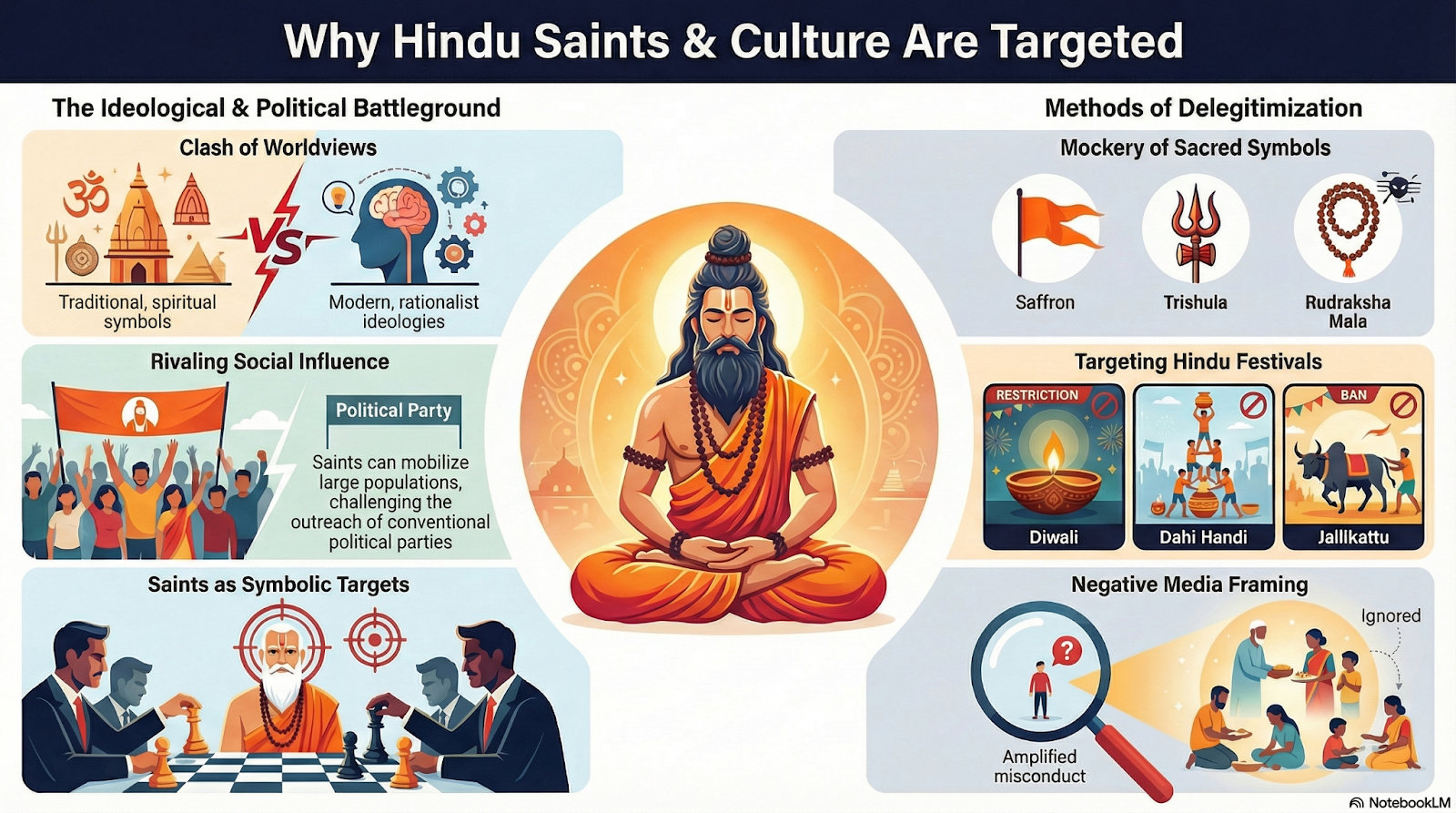
The antagonism towards Hindu saints is rooted in a fundamental clash of worldviews. The Left ecosystem views traditional religious authority and the monastic order as obstacles to their vision of “modernity” and “rationalism. Saints are seen as the guardians of a history and culture that the Left wishes to rewrite or erase. Because saints possess the power to mobilise vast sections of society—often rivalling political parties in their influence—they represent a direct threat to the Left’s political mobilisation efforts.
This conflict is exacerbated by the “Macaulay and Marx” mindset that pervades the Indian intellectual establishment. This “mental drug” has conditioned generations of Indians to view their own heritage with suspicion and Western ideologies with reverence. The ecosystem promotes a version of history that glorifies invaders like the Mughals while marginalising indigenous heroes. Leaders of the opposition and the ecosystem stand with figures like Aurangzeb—who destroyed temples—rather than the syncretic and philosophical Dara Shikoh, who translated the Upanishads and sought a meeting of two oceans.
By targeting saints, the Left aims to sever the link between the Indian masses and their civilizational roots. They stereotype saints as backward, anti-science, and politically motivated, reducing complex spiritual figures to caricatures to delegitimise the entire tradition. This is a calculated assault on the “Soft Power” of Hinduism.
The Institutional Imbalance: Waqf, Missionaries, and Temples
The persecution of Hindu institutions is not just a matter of social defamation but of structural inequality enshrined in law. A glaring example of this is the disparity between the management of Hindu temples and the privileges granted to other religious bodies.
While the government exercises control over Hindu temples, seizing their revenues and managing their affairs, it maintains a hands-off approach toward churches and mosques. Sudhanshu Trivedi, a prominent voice in this discourse, highlights the sheer absurdity of the situation regarding the Waqf Board. After the Indian Armed Forces and the Railways, the Waqf Board is the third-largest landholder in India. It possesses extraordinary powers to claim land, a privilege not granted to any other religious community, not Christians, Sikhs, Buddhists, or Hindus.
The Waqf Board in India holds more land than any Waqf board in the entire Islamic world, including in Saudi Arabia, Turkey, or Pakistan. This immense accumulation of property, often claimed without historical documentation from the Mughal era or British records, stands in stark contrast to the struggles of Hindu institutions. A Hindu temple, such as the Ram Mandir, pays crores in taxes to the government, while the Waqf generates minimal revenue relative to its massive assets and is virtually tax-exempt.
This imbalance creates a fertile ground for the “deep state” to operate. The ecosystem defends these privileges under the guise of secularism while attacking Hindu attempts to manage their own institutions (like Gurukuls) as “communal.” Mission schools and madrasas are given full freedom to expand and operate, whereas Hindu educational initiatives face regulatory hurdles and ideological scrutiny. This asymmetry ensures that the institutional capacity of Hinduism remains stunted while opposing forces expand their influence unchecked.
Double Standards in Cultural Discourse

The hypocrisy of the “Left-Liberal” ecosystem is perhaps most visible in the public discourse surrounding religious festivals. There is a cyclical pattern of shaming Hindu practices while maintaining silence on others.
As the sources illustrate, when Hindu festivals approach, the narrative shifts to environmental concerns and animal welfare. For Jallikattu, the concern is animal cruelty; for Shivratri, the “wastage” of milk is criticized; for Janmashtami, the height of the Dahi Handi is regulated; for Ram Navami, processions are stoned; and for Diwali, firecrackers are banned to prevent pollution. However, during Bakrid, there is silence regarding animal slaughter, and the environmental impact of other festivities is ignored.
This selective activism is designed to induce a sense of guilt among Hindus regarding their own traditions. It is a psychological operation to detach the youth from their culture. The ecosystem mocks sacred symbols like the Trishul (Trident) and the Shivling, subjecting them to slanderous interpretations under the guise of “freedom of expression”. Artists who create demeaning images of Hindu gods are celebrated as liberals, while anyone who objects is branded intolerant.
The Narrative of “Victimhood” and “Aggression”
The ecosystem is adept at playing the victim card. When action is taken against rioters or anti-national elements, the “gang of secular people” becomes active, petitioning the Supreme Court and creating an international outcry. They construct a narrative where the aggressor is portrayed as the victim, and the state’s attempt to maintain order is framed as oppression.
In the case of the Delhi riots or the Jahangirpuri violence, the ecosystem moved swiftly to protect the accused, securing stay orders and managing public perception. In contrast, when Hindu saints or activists are attacked or defamation campaigns are launched against them, the ecosystem ensures that their side of the story is buried. The narrative is strictly controlled to maintain the image of “Saffron Terror” and “Hindu aggression,” despite evidence to the contrary.
The Role of the Deep State in Perpetuating Chaos
The “Deep State” thrives on chaos. By keeping the country in a state of perpetual agitation—whether through protests against the CAA, farm laws, or Agnipath—they aim to destabilise the government and weaken the nation. The sources describe how an atmosphere of war is created for months on end, forcing the government to retreat on key reforms.
Hindu saints are often at the forefront of resisting these destabilisation efforts, rallying society towards unity and nationalism. Consequently, they become the primary targets of the deep state. The arrest of saints, the filing of fake cases, and the ensuing media circus are all calculated moves to neutralise these stabilising forces. The system is rigged to ensure that “those who shout slogans of shoes” (insulting the country) get bail easily, while those who stand for the nation face the full wrath of the law.
Conclusion: The Awakening
The assault on Hindu saints is not merely a series of isolated legal or media incidents; it is a symptom of a deeper malaise within the Indian system. It is a manifestation of a “2.5 front war” where the internal enemy—the ecosystem of leftists, liberals, and the deep state—works tirelessly to undermine the civilizational integrity of Bharat.
This ecosystem has monopolised the narrative for decades, creating a reality where the “Sharafat Ali” (the honest, patriotic citizen) is silenced by the “Shararat Khan” (the mischievous, anti-national element). They have distorted history, vilified sacred symbols, and weaponised the judiciary to target the guardians of Sanatan Dharma.
However, the veil is lifting. The relentless targeting of saints and the blatant double standards in dealing with religious institutions have begun to awaken the Hindu consciousness. The realisation is dawning that the “system” must be reclaimed, just as the government was. The defense of Hindu saints is not just about protecting individuals; it is about protecting the soul of a civilization that has survived for millennia. As the narrative shifts, the ecosystem’s monopoly is being challenged, exposing the deep-seated biases that have long governed the corridors of power. The battle for the narrative is on, and the protection of the saffron legacy stands at its very heart.