


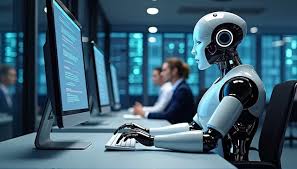
At a team meeting, someone casually says, “In a few years, AI will do most of this work anyway.”
A few people laugh. Someone nods.
But beneath the humour sits an uncomfortable silence.
“AI will replace all jobs.”
“Humans won’t be needed in the future.”
“Machines are coming for our livelihoods.”
These statements are everywhere—on social media, in office discussions, and even in family conversations. The rise of Artificial Intelligence has created excitement, but it has also fuelled anxiety. Many people genuinely fear that AI will make human workers obsolete.
But how much of this fear is grounded in reality—and how much of it is driven by headlines and panic?
Let’s break it down honestly, simply, and based on facts rather than fear.

Myth 1: The ‘Job Apocalypse’ — AI Will Replace All Human Jobs
This is the most common and dramatic belief. The idea that machines will eventually do everything—leaving humans without work—sounds convincing when we see AI writing content, analysing data, or answering customer queries.
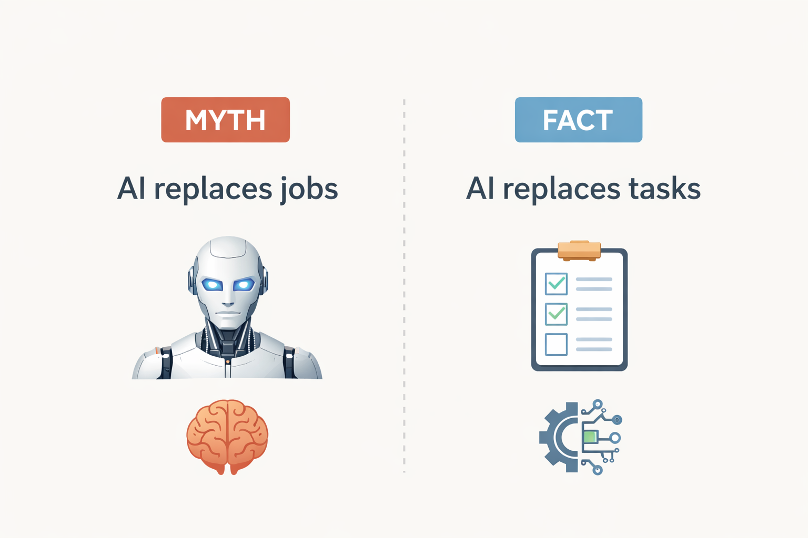
Fact: AI does not replace jobs; it replaces tasks.
Most jobs are made up of multiple tasks—some repetitive, some creative, some emotional, and some strategic. AI is excellent at handling repetitive, rule-based, and data-heavy tasks. However, it struggles with:
- Emotional intelligence
- Ethical judgement
- Creativity with context
- Complex human interaction
- Leadership and decision-making under uncertainty
For example, AI can assist doctors by analysing scans, but it cannot replace a doctor’s judgement, empathy, or responsibility towards patients. Similarly, AI can help auditors analyse large datasets, but professional scepticism and understanding business realities remain human-led.
Jobs evolve—they don’t vanish overnight.
Myth 2: AI Is Only a Threat, Not an Opportunity
Many people see AI as a competitor rather than a tool. This mindset creates resistance and fear.
Fact: AI is more of a collaborator than a competitor.
Historically, every major technological shift—from the industrial revolution to computers—sparked similar fears. Typists feared computers, accountants feared Excel, and shopkeepers feared e-commerce. Yet, these technologies created new roles while transforming existing ones.
AI is doing the same by:
- Increasing productivity
- Reducing manual workload
- Allowing professionals to focus on higher-value tasks
- Creating entirely new career paths (AI ethics, prompt engineering, data governance, AI auditing, etc.)
Those who learn to work with AI often become more valuable—not less.
Myth 3: Only Low-Skilled Jobs Are at Risk
There is a common assumption that AI will only impact blue-collar or entry-level jobs.
Fact: AI affects tasks across all skill levels, not just low-skilled work.
AI can draft legal documents, analyse financial data, generate reports, and even assist in research. This means professionals, managers, and executives are also impacted. However, the impact is not replacement—it is reshaping.
Roles that rely solely on routine processes are more vulnerable, regardless of skill level. On the other hand, roles that require judgement, adaptability, and human understanding become even more important.
In short, AI doesn’t target who you are—it targets how repetitive your work is.
Myth 4: AI Thinks Like Humans
Movies and headlines often portray AI as a thinking, conscious entity capable of independent decisions.
Fact: AI does not “think”; it predicts.
AI systems work by analysing patterns in large datasets and predicting outcomes based on probabilities. They do not understand context, emotions, morality, or consequences the way humans do.
AI has:
- No consciousness
- No intent
- No moral responsibility
Humans design it, train it, supervise it, and are responsible for its outcomes. This is precisely why human oversight is not optional—it is essential.

Myth 5: Learning AI Is Only for Tech Experts
Many people feel overwhelmed, believing AI knowledge is only for engineers or programmers.
Fact: AI literacy is becoming a basic professional skill, not a technical specialisation.
You don’t need to build AI systems to benefit from them. Understanding how to:
- Use AI tools responsibly
- Ask better questions (prompts)
- Validate AI outputs
- Recognise limitations and biases
These skills are becoming relevant across fields—finance, education, healthcare, law, marketing, and audit.
The goal is not to become an AI expert, but an AI-aware professional.
What Experts and Research Say
According to reports by organisations like the World Economic Forum and McKinsey:
- AI will displace some roles, but create more new roles overall
- Jobs involving human interaction, creativity, and judgement will grow
- Upskilling and reskilling will be key to future employability
The real risk is not AI itself—but failing to adapt to change.
The Real Question We Should Be Asking
Instead of asking,
“Will AI replace my job?”
A better question is:
“How will AI change my job, and how can I stay relevant?”
History shows that those who adapt early benefit the most. Those who resist change often struggle—not because technology replaces them, but because they refuse to evolve.
Final Thought: Fear Is Understandable, But Not Inevitable
AI is powerful, yes—but it is not unstoppable without humans. It needs guidance, ethics, supervision, and purpose. Jobs will change, skills will shift, and roles will evolve.
But human value will not disappear.
The future of work is not humans vs machines.
It is humans with machines.
And in that future, the most irreplaceable skill won’t be coding or automation—it will be the ability to learn, adapt, and think beyond fear.
Technology doesn’t eliminate human value—it exposes whether we’ve been growing it.