


India – Sowing Windows & Major Growing States
- Summer crop: 1 January – 28 February
States: Bihar, Haryana, Uttar Pradesh, Punjab, Chhattisgarh, Odisha, Assam, Andhra Pradesh, Telangana - Monsoon crop: 1 June – 31 July
States: Bihar, Haryana, Uttar Pradesh, Punjab, Chhattisgarh, Odisha, Assam
Crop Overview
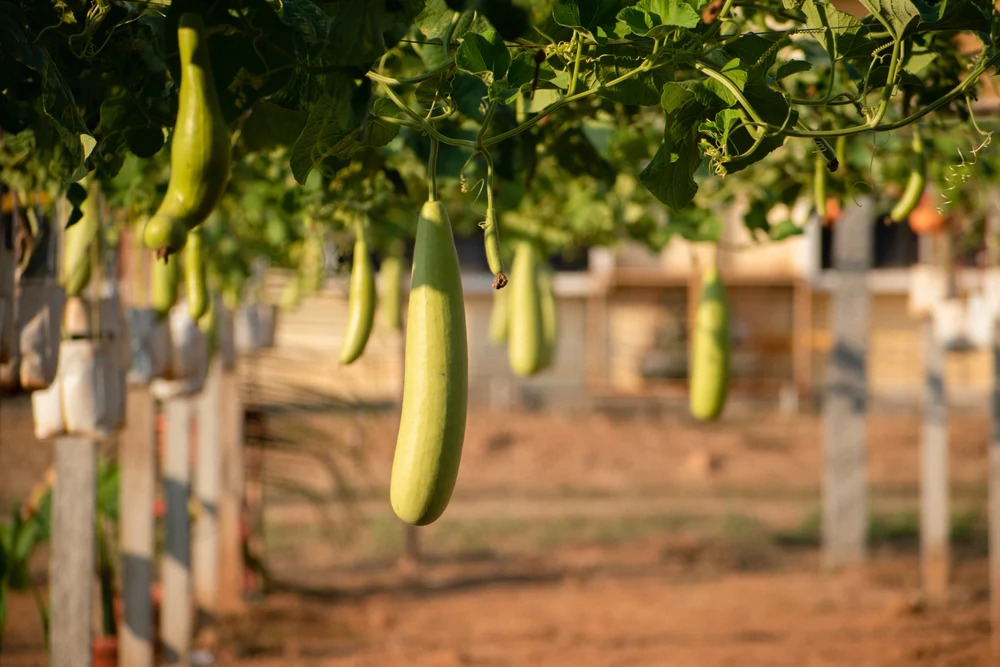
Bottle gourd is a widely cultivated vegetable vine grown for its tender fruits. When harvested young, it is consumed as a vegetable; when fully mature and dried, its hard shell is used as containers, utensils, or musical instruments.
- Common names: Ghia/Lauki (Hindi), Sorakya/Anapakaya (Telugu), Soreikai/Chorakkai (Tamil), Chorakaa (Malayalam), Sorekai (Kannada), Zeeth (Kashmiri)
- Scientific name: Lagenaria siceraria
- Family: Cucurbitaceae
In India, bottle gourd is an important commercial vegetable crop. Bihar is among the leading producers.
Climate Requirement
- Best suited to warm and moist climates
- Cannot tolerate frost; requires at least 4 frost-free months
- Optimal temperature: 20–32°C
- Performs poorly under cold stress or prolonged low temperatures
Soil Requirement
- Can grow in a wide range of soils
- Performs best in sandy loam soils with good drainage
- Ideal soil pH: 6.5–7.5
- Poorly drained soils increase the risk of root diseases
Land Preparation
- Prepare land to a fine tilth with 6–7 ploughings followed by harrowing
- Incorporate well-decomposed farmyard manure (FYM) to enrich soil organic matter
- Good land preparation improves root growth, nutrient uptake, and yield
Season & Sowing Time
- Summer crop: January to end of February (plains)
- Monsoon crop: June–July (plains); April in hilly regions
- Avoid frost-prone periods and waterlogged conditions
Seed Rate & Seed Treatment
- Seed rate: 3.5–6.0 kg/ha
- Seed treatment (any one):
- Pseudomonas fluorescens @ 10 g/kg seed
- Trichoderma viride @ 4 g/kg seed
- Carbendazim @ 2 g/kg seed
Seed treatment helps prevent seed- and soil-borne diseases.
Spacing & Sowing Method
- Method: Dibbling
- Spacing: 2–3 m × 1.0–1.5 m
- Depth: 2.5–3.0 cm
- Sow 2–3 seeds per pit; thin to retain healthy seedlings
Recommended Varieties
| Developing Institution | Variety | Key Features |
|---|---|---|
| IIHR, Bengaluru | Arka Bahar | Straight, light-green fruits; ~1 kg; yield 40–50 t/ha |
| IARI, New Delhi | Pusa Naveen | Cylindrical, straight fruits; ~550 g |
| NDAU&T, Faizabad | Narendra Rashmi | Tolerant to pumpkin beetle; ~1 kg; yield ~30 t/ha |
| PAU, Ludhiana | Pusa Komal | Early (70 DAS), CMV tolerant; yield ~40 t/ha |
Nutrient Management
- Apply 20 t/ha FYM during land preparation
- Basal dose per pit: 100 g NPK (6:2:12)
- Top dressing: 10 g Nitrogen per pit at 30 days after sowing
- Before last ploughing, apply bio-inputs:
- Azospirillum & Phosphobacteria @ 2 kg/ha
- Pseudomonas @ 3 kg/ha
- Along with 50 kg FYM and 100 kg neem cake
Irrigation Management
- Immediate irrigation after sowing is beneficial
- Summer crop: irrigate every 3–4 days
- Winter crop: irrigate as needed
- Rainy season crop: usually does not require irrigation
- Drip irrigation is recommended for water efficiency and uniform growth
Harvesting
- Ready for harvest 60–70 days after sowing, depending on variety and season
- Harvest tender, green fruits as per market demand
- Use a sharp knife for cutting fruits
- Avoid delayed harvesting; over-mature fruits become hard and lose market value
Yield
- Average yield: 100–120 quintals per hectare
- Yield depends on variety, season, soil fertility, and crop management
Conclusion
Bottle gourd cultivation is profitable when grown under suitable climate and soil conditions. Proper land preparation, timely sowing, balanced nutrition, and correct irrigation practices ensure healthy vines and high yields. Harvesting at the right stage is crucial for better quality and market returns.