


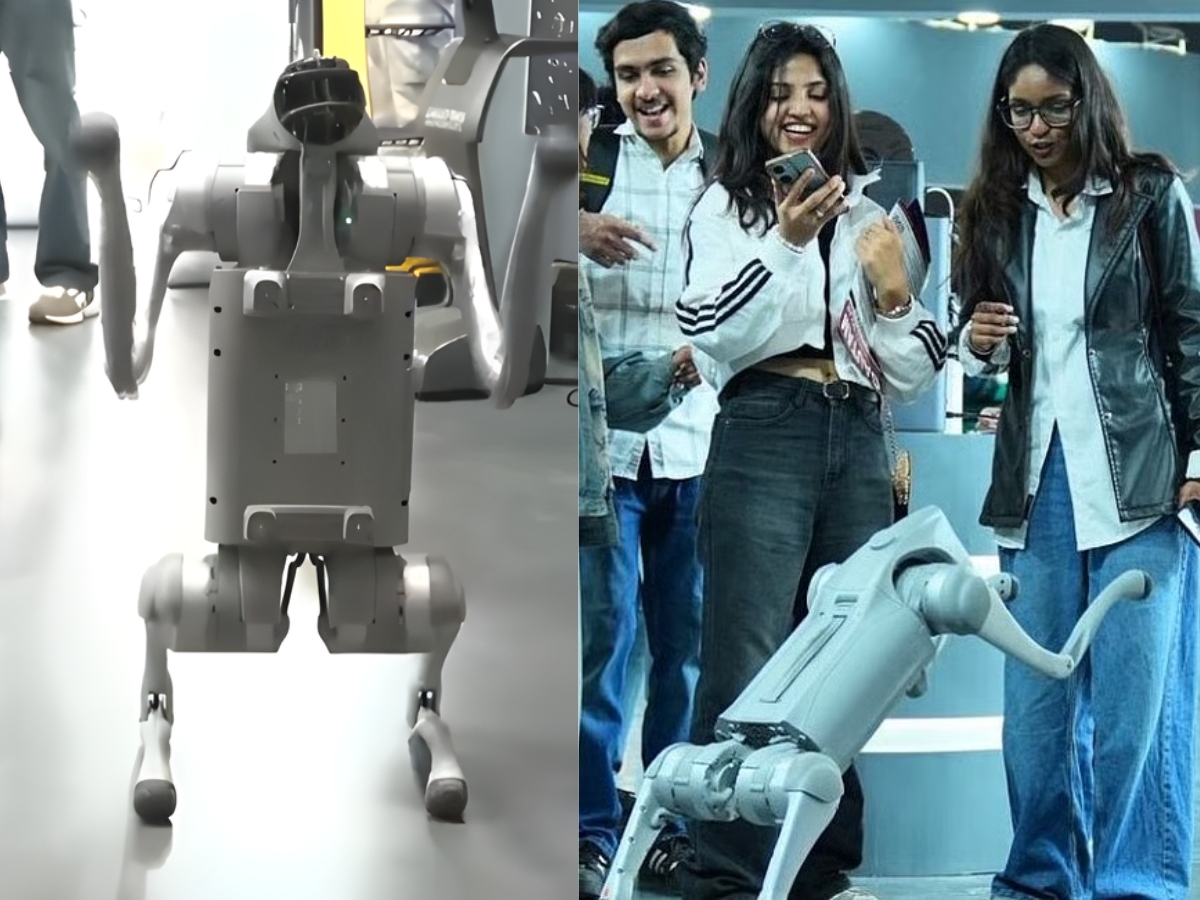
What was supposed to be a proud showcase of India’s AI ambition at the India AI Impact Summit 2026 turned into an awkward headline moment.
At Bharat Mandapam, a robotic dog displayed by Galgotias University under the name “Orion” was quickly identified by observers as the Unitree Go2, a commercially available quadruped robot made by Chinese robotics firm Unitree.
Yes, the same robot that is available in India for around ₹2–3 lakh.
Soon after the identification, government sources confirmed that the university was asked to vacate its stall. Reports suggest that power supply at the pavilion was also cut after scrutiny intensified.
What Triggered the Controversy?
During a media interaction, Professor Neha Singh described the robot as an innovation developed by the university’s Centre of Excellence. She spoke about the institution’s ₹350 crore AI investment and mentioned that the robot could perform surveillance and monitoring tasks.
However, tech observers quickly pointed out that the robot matched the design and specifications of Unitree’s Go2 model. The debate then shifted from “AI innovation” to “AI representation.”
The bigger question wasn’t just about the robot. It was about optics.
At a summit inaugurated by the Prime Minister and positioned as a flagship AI event for India, critics argued that showcasing an imported product as domestic innovation sends the wrong message.
Political Fire Adds More Heat
The controversy didn’t stay technical for long.
Opposition leaders reacted sharply on social media. Congress termed the episode “embarrassing” and accused the government of turning the AI summit into a spectacle. Rahul Gandhi called it a “disorganised PR event,” raising concerns about India’s global AI image.
Suddenly, a robot dog became a political talking point.
University’s Clarification
Galgotias University issued statements clarifying that they never claimed to have manufactured the robot. According to them, the purpose of displaying it was educational — to expose students to global technologies and inspire innovation.
Professor Neha Singh later acknowledged that communication may not have been clear and took responsibility for the misunderstanding. She stated that the robot was introduced as a learning tool, not as a made-in-house product.
Tadka Talks Take
Here’s the real issue: In the AI race, perception matters as much as performance.
If the goal is to position India as a global AI leader, clarity and transparency are non-negotiable. Showcasing global tech for learning is absolutely valid. But in high-stakes national events, messaging has to be airtight.
The AI Summit was meant to highlight India’s data power, startup ecosystem, and domestic innovation. Instead, the spotlight shifted to a robot’s origin story.
Lesson learned?
In the age of AI, you can’t bluff the internet.