


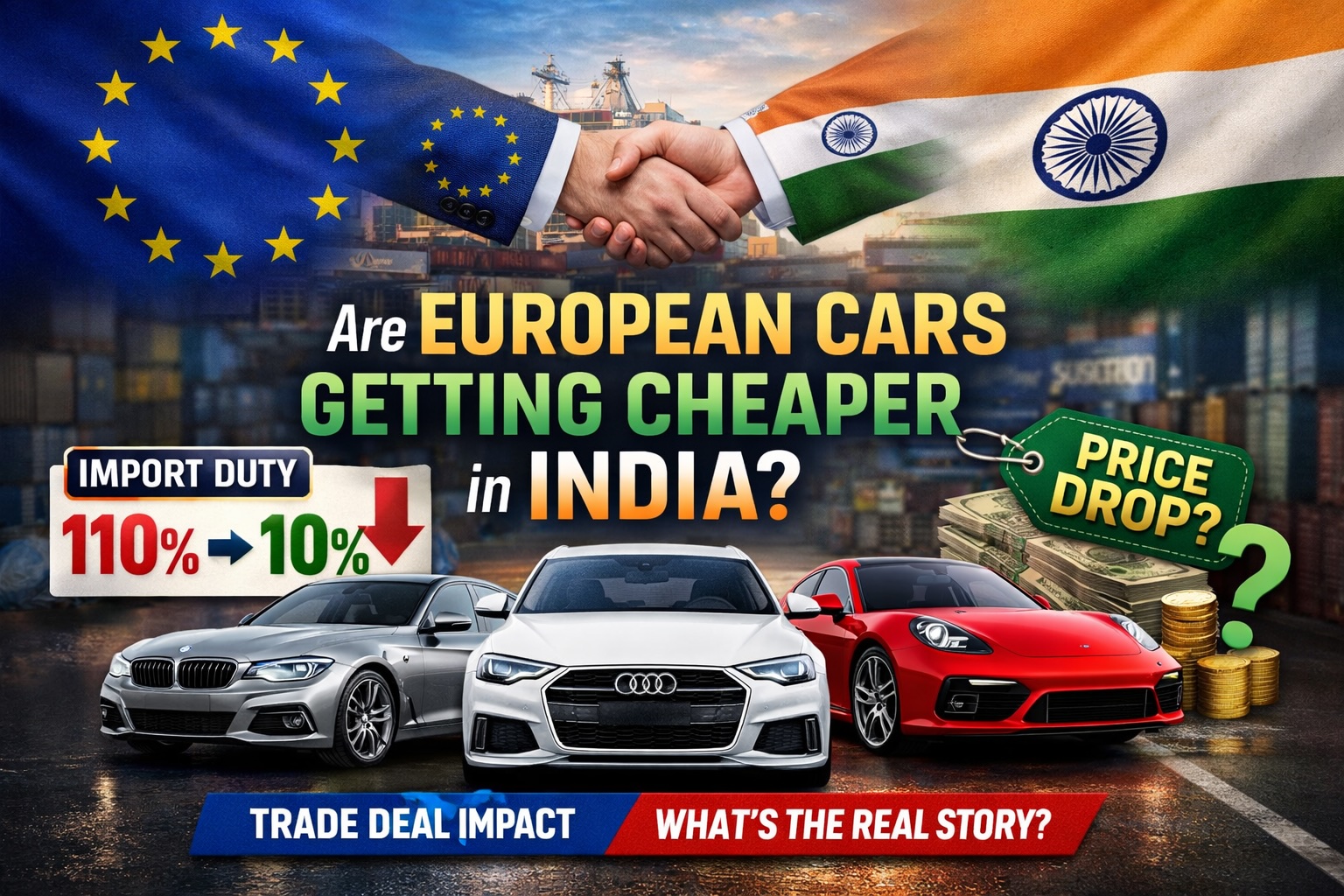
In early 2026, the long-awaited India–European Union Free Trade Agreement (India–EU FTA) was finally concluded after nearly two decades of negotiation. One of the most talked-about aspects of this deal has been the anticipated drop in prices for imported European cars in India. Headlines and social media posts suggested that iconic luxury brands like Mercedes-Benz, BMW, Audi, and Porsche could soon be sold at significantly lower prices in the Indian market. But is this really true? Or is it just media hype?
This article breaks down what the treaty really says, why European cars might not become dramatically cheaper, what segments will benefit the most, and what this could mean for Indian consumers and the automotive industry.
What the India–EU Trade Deal Actually Does
The India–EU FTA, signed in January 2026, is a comprehensive trade pact aimed at boosting economic integration between India and the European Union. Under its terms:
- India will reduce or eliminate tariffs on a large range of European exports, including cars, wine, spirits, machinery, and food products.
- For automobiles, India has agreed to gradually cut import duties on fully imported cars (CBUs) currently taxed as high as 110% down to as low as 10% over a phased period.
- Annual quotas will allow up to 250,000 European-made cars to be imported under these preferential rates.
That headline figure — from 110% to 10% tariffs — is the basis for many optimistic claims about cheaper imported cars in India.
Why Most European Cars May NotGet Cheaper Immediately
1. Phased Implementation, Not Instant Price Slashes
The tariff reduction will be phased over several years, not overnight. Initial cuts may lower duties to around 40% to 35%, with further reductions taking place gradually.
This means that European car prices won’t suddenly drop to affordable levels right away, especially for everyday luxury models.
2. Local Assembly Dilutes the Effect
More than 90% of European cars sold in India — including popular models from Mercedes-Benz, BMW, Audi, and Volkswagen — are already assembled locally in India from imported kits (CKD). These cars face much lower duties than fully imported units, and the tariff cuts under the FTA apply mainly to CBUs.
Consequently, for most of the cars already on sale, prices may not change significantly since they aren’t subject to the higher 110% tariffs that are being reduced.
3. Exchange Rates and Costs Still Matter
Reduced tariffs are just one part of the pricing equation. Other factors, such as global supply chain costs, currency fluctuations, freight, and dealer margins, continue to influence final pricing. Even if duties are lowered, these other factors could offset some of the potential reductions.
Which Cars Might Actually Become Cheaper
Although the average imported European car may not suddenly drop in price, some categories are likely to see real savings, particularly:
Fully Imported Luxury and Speciality Models
- Ultra-luxury cars like Rolls-Royce, Bentley, Lamborghini, Ferrari, and high-performance versions from Porsche and Mercedes-AMG will benefit most because they are often imported as CBUs.
- A tariff reduction from around 110% to 40% or even 10% could significantly cut the cost of these vehicles in India — though prices will still remain high due to the nature of these premium products.
For example, some reports suggest that price tags on ultra-premium vehicles could fall by millions of rupees in real terms once tariff cuts are fully phased in.
Market Reaction and Industry Response
The news of tariff cuts under the India–EU FTA has already impacted financial markets. Investors reacted swiftly as shares of Indian automobile companies such as Mahindra, Tata, and Hyundai dipped, reflecting concerns about potential competitive pressure from European manufacturers.
Despite this reaction, local manufacturers continue to control the mainstream market — especially in mass-market segments where affordability and fuel-efficiency are major consumer priorities.
Electric Vehicles (EVs) Are Mostly Excluded — For Now
Another important factor is that electric vehicles (EVs) are currently excluded from the initial tariff cuts under the India–EU trade deal. These cuts will only come into effect after a further five years, likely to protect growing Indian EV manufacturers such as Tata Motors and Mahindra.
This means that European electric cars may not see significant price changes for some years, even under the FTA.
What This Means for Indian Consumers
✔ Luxury Buyers
Affluent buyers targeting ultra-premium imports stand to benefit the most, especially over the long term when full tariff reductions are in place.
✔ General Car Buyers
For the average Indian buyer looking at mainstream European brand models — many of which are assembled locally — significant price drops are unlikely in the short term.
✔ Market Choice Could Improve
Even without dramatic price reductions, the easing of tariffs may encourage manufacturers to introduce more models to the Indian market, increasing consumer choice and variety.
Balancing Protection and Liberalisation
India’s strategy appears to be a balanced approach:
- It protects key domestic manufacturing interests,
- Allows gradual access for premium imports,
- Secures better market access for Indian exports to the EU in goods such as textiles, pharmaceuticals, machinery, and wines.
This careful calibration aims to ensure that the domestic automotive industry isn’t blindsided by imported competition, while giving consumers future access to a wider range of cars.
Timeline to Watch
Most analysts suggest that tangible price impacts from the tariff reductions will only emerge a few years after the FTA takes effect, likely closer to 2027–2028 and beyond.
This phased implementation keeps European manufacturers engaged in the market and allows India to protect nascent domestic technology sectors, such as EVs.
Tadka Talk’s Final Verdict
So, are European cars becoming cheaper in India because of the EU–India trade deal? — Yes, but with important caveats.
✔ Tariffs will fall significantly over time.
✔ Ultra-premium imported cars will benefit the most.
❌ Most locally assembled European models may not become much cheaper soon.
❌ EVs won’t see major tariff reductions until later.
In short, the deal marks a huge structural change in policy, but immediate, dramatic price drops for European cars in India are unlikely for most buyers in the short term.