


Introduction: The Tournament of Paradoxes
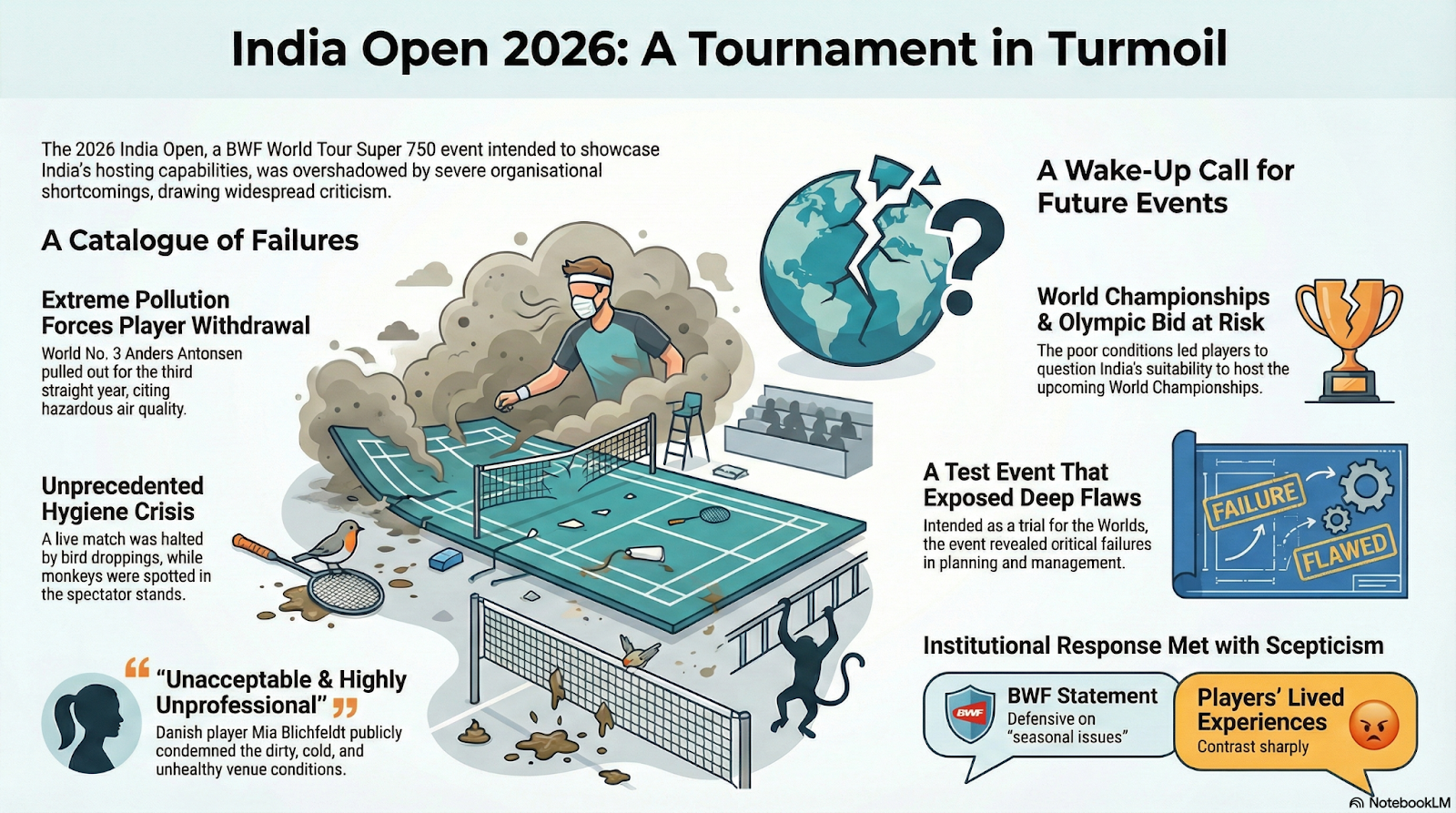
There is no clearer illustration of the current state of international badminton than the India Open 2026. On one hand, the tournament boasted an elite BWF Super 750 status and a staggering US$950,000 prize purse, drawing global icons to the massive Indira Gandhi Indoor (IGI) Stadium. On the other, a high-stakes quarter-final had to be halted so officials could scrub bird droppings off the court. This was the “test event” for the upcoming August World Championships—a week where the brilliance of the world’s best shuttlers was forced to compete for headlines with hazardous air, monkeys in the gallery, and a venue that felt more like a drafty hangar than a world-class arena.
Point 1: The High Price of Breathing (The Antonsen Boycott)
The tournament’s prestige took an immediate hit when World No. 3 Anders Antonsen withdrew for the third consecutive year. The Danish star refused to subject his lungs to New Delhi’s air quality, which hit a “hazardous” 348 on the Air Quality Index (AQI) during the event. While the BWF prioritized its calendar by slapping Antonsen with a US$5,000 fine, the reality on the ground validated his concerns. Even those who stayed, like Singapore’s Loh Kean Yew, admitted to a compromised experience.
“Due to the extreme pollution in Delhi at the moment, I don’t think it’s a place to host a badminton tournament. Crossing my fingers that it will be better in the Summer when the World Championships will take place in Delhi.” — Anders Antonsen via Instagram.
“I’m breathing less. I wear a mask whenever I can. I try to stay indoors as much as possible, but the pollution is very high and needs to be fixed immediately.” — Loh Kean Yew.
Point 2: When the Venue Becomes the Opponent (The “Drift” and the Pigeons)
At the Super 750 level, the physical arena is as much a factor as the opponent. The IGI Stadium’s massive volume creates “volume-induced air currents” known as the drift, which turned matches into tactical nightmares. This was most evident in Lakshya Sen’s quarter-final loss to Lin Chun-yi. Sen controlled the opening game from the “fast side,” but the match turned when they changed ends. From the “slow side,” Sen’s technical precision vanished; his lifts betrayed him, falling a fraction too long or loose, inviting Lin’s pouncing smashes. Sen later admitted he was “shaky at the net” and had failed to recalibrate to the shifting wind.
Environmental Obstacles at IGI Stadium:
- Pollution: Hazardous 348 AQI levels affecting respiratory recovery and forcing players to stay masked indoors.
- Internal Drift: Volume-induced air currents within the massive hall, creating a distinct “fast side” and “slow side” that dictated tactical lifts and net play.
- Hygiene Failures: Pigeons nesting in the high altars and monkey sightings in the spectator gallery, leading to mid-match cleaning delays for bird droppings.
Point 3: The “Independent” Path to Victory (Jonatan Christie’s Masterclass)
Amidst the logistical friction, Indonesia’s Jonatan Christie provided a masterclass in professional focus. Currently World No. 4, Christie’s success is a vindication of his mid-2025 decision to leave the Indonesian national setup. To maintain his elite level as an independent, he manages “Team Christie”—a bespoke unit including a psychologist, physical trainer, physiotherapist, and nutritionist—all while paying for his own training facilities.
In the semi-final against Loh Kean Yew, Christie’s tactical maturity shone. Trailing 5-11 in the first game and 13-17 in the second, he resisted the urge to engage in a high-speed shootout. Instead, he slowed the pace, drawing Loh into long, energy-sapping rallies and capitalising on unforced errors. The result was a clinical 21-18, 22-20 victory that extended his winning streak over Loh to 9-0.
“When I had my family, I decided to go independent. It gives me more balance in practice and spending time with my family. It allows me more flexibility.” — Jonatan Christie.
Point 4: A “Test Event” With Serious Cracks
The BWF and the Badminton Association of India (BAI) have framed this tournament as a vital rehearsal for the World Championships this August. However, the gap between administrative defense and athlete reality is cavernous. While the BWF highlighted infrastructure “upgrades” like better flooring and medical rooms, players described the environment as “unprofessional.” The response from BAI General Secretary Sanjay Mishra to these concerns was a classic study in administrative deflection, suggesting player complaints were merely personal health idiosyncrasies.
“I had mentally prepared myself for ‘the worst’ once again, but the conditions surrounding us are simply unacceptable and highly unprofessional… I find it very difficult to see how a World Championship could be held here.” — Mia Blichfeldt via Instagram.
“Mia has some issues with dust and allergies; we can’t say anything about that. Players and coaches have appreciated the work BAI has put into this tournament.” — Sanjay Mishra, BAI General Secretary.
Point 5: The Changing of the Indian Guard
The tournament offered a sobering technical audit of the Indian contingent. PV Sindhu, the vanguard of the national team, suffered a Round of 32 exit to Vietnam’s Nguyễn Thùy Linh. The loss was a clear issue of fatigue; Sindhu arrived in New Delhi after a deep run in the Malaysia Open and struggled with the physical demands of Thùy Linh’s lateral rallies.
While the veterans showed signs of transition, the “developmental pipeline” flashed high potential. The standout was 17-year-old Tanvi Sharma, who pushed World No. 2 Wang Zhiyi to a full three games. Sharma’s fearlessness against top-tier competition suggests that while India’s current stars are flagging, the next generation is technically prepared for the Super 750 stage.
Conclusion: The Road to August
The India Open 2026 was a tournament of unmet expectations that exposed the friction between India’s athletic potential and its administrative reality. While the BWF claims the Indira Gandhi Indoor Stadium meets “Field of Play” requirements, the image of monkeys in the stands and hazardous air in the lungs tells a different story. As New Delhi prepares to host the World Championships in August, the global federation faces a crisis of integrity: should a city be allowed to host a marquee event when it cannot guarantee a healthy, animal-free environment for its athletes? If the lessons of this “test event” are dismissed as mere “allergies,” the badminton world may find that India is simply not yet ready for the world stage.