


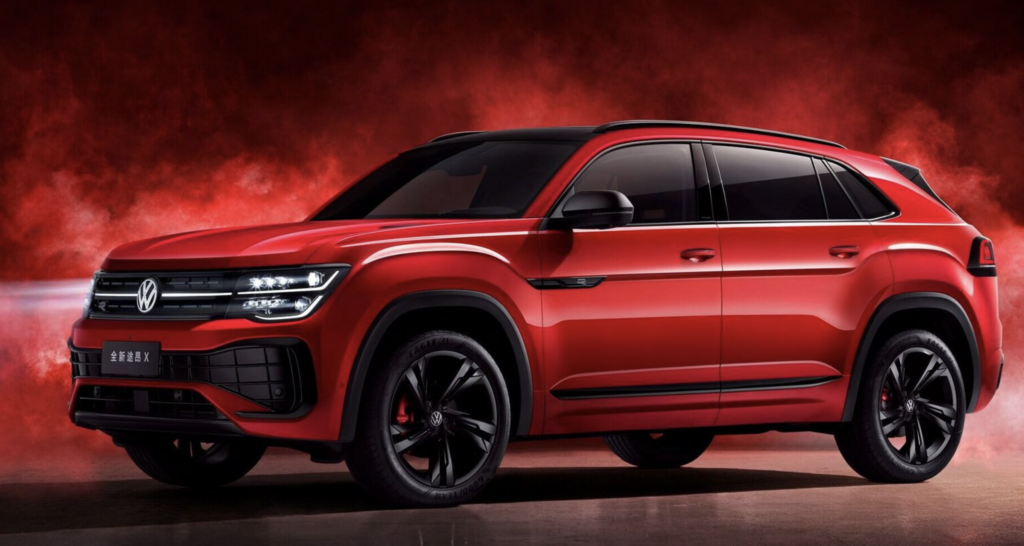
The Indian automotive landscape is undergoing a structural metamorphosis. For decades, the “first car” narrative in India was synonymous with the compact hatchback—a frugal, utilitarian entry point into personal mobility. However, as we move through 2025, that narrative has been rewritten. The market has pivoted decisively toward the Compact and Mid-size Sport Utility Vehicle (SUV).
This deep-dive guide explores the economic and psychological drivers behind this shift, analyses the petrol versus electric dilemma for 2025, and provides a masterclass in negotiation and inspection for the modern first-time buyer.
The Death of the “Small Car” and the Rise of the SUV
The statistics paint a stark picture of a changing nation. Between 2015 and 2025, the Indian passenger vehicle market witnessed a hollowing out of the “bottom of the pyramid.”
The Numbers Behind the Shift
In 2015, the “A” segment (entry-level small cars like the Alto) commanded a 14% market share. By 2025, this collapsed to a mere 2.6%, representing a negative Compound Annual Growth Rate (CAGR) of 9.6%. Similarly, the “B” segment (hatchbacks) saw its dominance erode from 36% in 2015 to just 20% in 2025.
In contrast, the “C” segment—comprising compact and mid-size SUVs—has become the undisputed king. From a 31.4% share in 2015, it now controls over 54.4% of the market as of 2025.
Why the Shift? The Psychology of “Premiumisation”
This transition is not merely about changing tastes; it is driven by “Premiumisation”—a structural trend where economic progress meets aspiration.
- The “Pseudo” SUV Appeal: Technically, many popular Indian SUVs are “faux SUVs” or crossovers built on unibody frames rather than rugged ladder-frames. However, they offer a “commanding driving position” and higher ground clearance. In a country where roads are often riddled with potholes or subject to waterlogging, high ground clearance is perceived as a functional necessity, not just a luxury.
- Safety Perception: There is a growing belief among Indian buyers that larger vehicles are inherently safer. While this isn’t always technically true without checking crash ratings, the imposing size of an SUV provides a psychological sense of security that small hatchbacks struggle to match.
- Status and Identity: In India, a car is rarely just a tool for transport; it is a “vessel for creating memories” and a projection of identity. The SUV has replaced the sedan as the primary symbol of having “arrived” in life.
- Engel’s Law in Action: As per-capita GDP rises (approaching $2,800), spending on basic necessities drops as a percentage of income, freeing up capital for discretionary, aspirational purchases. The modern Indian buyer is no longer asking “Kitna deti hai?” (How much mileage?), but rather, “Does it have a sunroof?”.
The “FOMO” Factor and Feature Selection
For the first-time buyer in 2025, the decision-making process is heavily influenced by the “Fear of Missing Out” (FOMO). This phenomenon has created an “absence penalty” in the market.
The Absence Penalty
If a car model lacks a specific feature that is standard in 40% of the segment, it faces an 18–22% drop in purchase consideration, even if the buyer rarely uses that feature. This forces manufacturers to pack entry-level cars with premium tech.
Must-Have vs. Good-to-Have Features
Buyers are paying premiums of ₹80,000 to ₹2 lakh for features used less than 5% of the time. To buy smart, one must distinguish between utility and vanity:
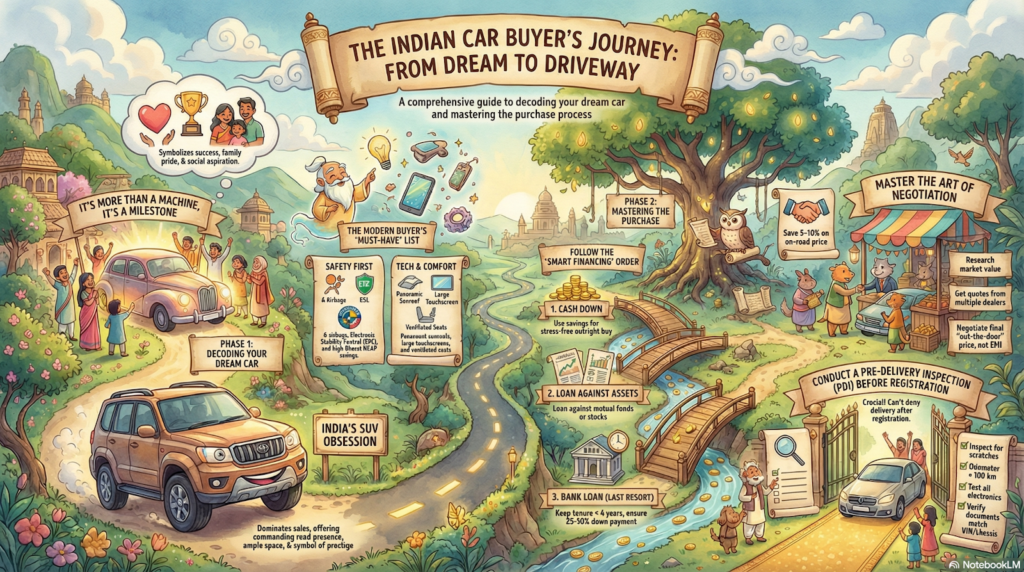
- Non-Negotiable Safety: In 2025, safety expectations have skyrocketed. Six airbags, Electronic Stability Control (ESC), and ABS with EBD are now baseline expectations. High safety ratings (Bharat NCAP or Global NCAP) are increasingly influencing decisions.
- The Sunroof Craze: Once exclusive to luxury cars, the sunroof is now a “lifestyle statement” available even in hatchbacks like the Hyundai i20. While it enhances cabin ambience, it is often a vanity metric driving up costs.
- Connectivity: Large touchscreens (10-12 inches), wireless Android Auto/Apple CarPlay, and connected car tech are now standard expectations, even in the ₹10-15 lakh bracket.
The Fuel Dilemma (Petrol vs. Hybrid vs. EV)
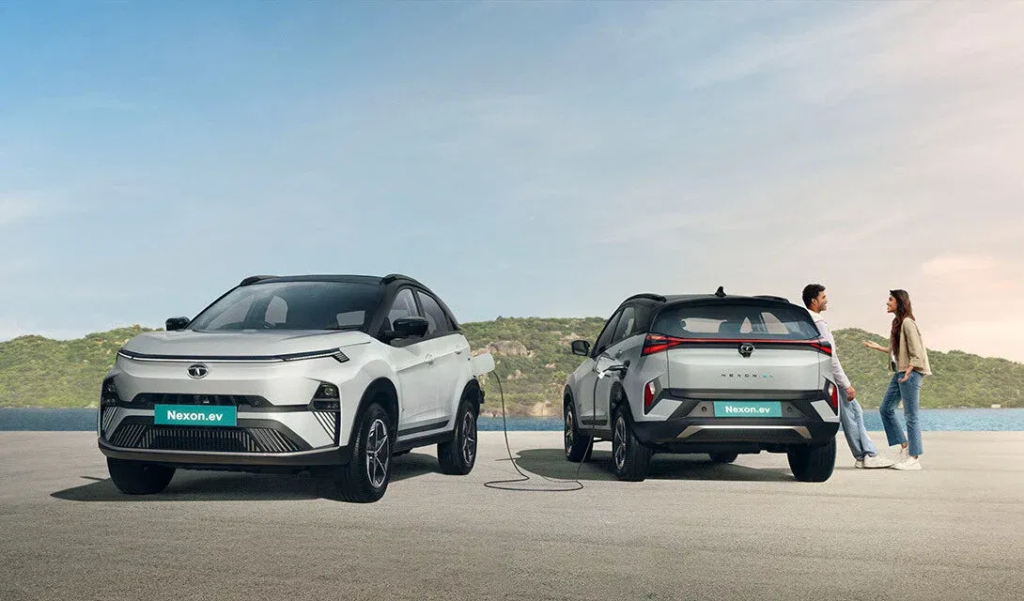
The 2025 buyer faces a critical choice regarding powertrain.
1. The Case for EVs Electric Vehicles (EVs) have moved beyond early adopters. With petrol prices hovering between ₹100-115/liter, the running cost of a petrol SUV is roughly ₹6.7–₹7.6 per km. In contrast, an EV costs roughly ₹1.2–₹1.5 per km to run.
- Economics: Over a 5-year period (driving 12,000 km/year), an EV owner saves approximately ₹60,000–₹75,000 annually on fuel alone.
- Maintenance: EVs have fewer moving parts (no engine oil, no clutch), reducing maintenance costs by roughly 50% compared to petrol cars.
2. The Case for Hybrids Hybrids have emerged as a practical middle ground, surging in popularity. A survey in late 2025 indicated that 38% of consumers preferred hybrids, surpassing both petrol and EVs.
- Why Hybrid? They offer mileage of 22–28 km/l (real-world), drastically cutting fuel bills without the “range anxiety” associated with EVs. They are ideal for city drivers who lack dedicated charging infrastructure.
3. The Verdict
- Choose EV if: You have home charging and drive mostly within city limits (daily commute <100km).
- Choose Hybrid if: You want high fuel efficiency but frequently travel long distances where charging infrastructure is sparse.
- Choose Petrol if: Your annual running is low (<8,000 km) and you want the lowest upfront purchase price.
Buying Smart – Tips, Tricks, and Negotiation
Once the car is selected, the battle shifts to the dealership. Car brands and dealers use sophisticated psychology to maximize profits.
1. Beware the “Base Variant” Trap
Car brands often price the base variant aggressively low to lure you into the showroom—this is the “affordability trick”. However, manufacturers deliberately strip these variants of essential features (like power windows or central locking) and keep production low to create artificial waiting periods. The goal is to frustrate you into upgrading to a higher, more profitable variant.
- Strategy: If your budget is strict, consider the mid-variant of a segment lower rather than the base variant of a segment higher.
2. The Negotiation Playbook
Dealers have margins of 2-6% on the ex-showroom price, but margins on accessories and insurance can exceed 50-100%.
- Focus on OTR: Negotiate on the “On-Road Price,” not the ex-showroom price. Dealers often inflate the OTR with hidden charges.
- Timing: Buy at the end of the month or quarter when dealers are desperate to meet quotas. December is particularly good for discounts as dealers clear inventory.
- Insurance: Never blindly accept the dealer’s insurance quote. It is often inflated. Get quotes from online aggregators (like PolicyBazaar or Acko) and ask the dealer to match them. You are not legally obligated to buy insurance from the dealer.
- Handling Charges: Many dealers add “Logistic” or “Handling” charges (₹7,000 – ₹20,000). Multiple court judgments and transport commissioner notifications have deemed these illegal. Politely but firmly refuse to pay them, citing these rulings.
3. The Finance Trap
Avoid discussing monthly EMIs early in the negotiation. Dealers use “low EMI” offers to mask high interest rates or longer tenures. Calculate the total cost of ownership. The general rule is the 20-4-10 rule (20% down payment, 4-year loan tenure, EMI not more than 10% of monthly income), though in India’s aspirational market, many stretch this. A more realistic check: The total cost of the car (on-road) should ideally not exceed your annual income.
The Final Hurdle – VIN Decoding and PDI
Before you sign the final papers or register the car, you must perform a Pre-Delivery Inspection (PDI). Once the car is registered in your name, you cannot return it, even if it has defects.
Decoding the VIN (Vehicle Identification Number)
Dealers may try to pass off an older car (manufactured 6+ months ago) as “new.” You can catch this by decoding the 17-digit VIN found on the chassis.
- Year Code: For most manufacturers (Hyundai, Honda, Maruti, Tata), the 10th character of the VIN denotes the year.
- S = 2025
- T = 2026.
- Month Code: This varies by manufacturer. For example, in Maruti cars, if the 10th/11th digits are not ’00’, the 11th character denotes the month (A=Jan, B=Feb… H=Aug). For Tata Motors, the 12th letter usually denotes the month.
- Tip: If the car is more than 3-4 months old, demand a significant discount or reject the vehicle.
The PDI Checklist
Perform this inspection in broad daylight.
- Odometer: It should be under 50-100 km. If it’s higher, the car may have been used for test drives or disconnected from the odometer during transit.
- Exterior: Check for repainted spots (ripples in paint), scratches, or uneven panel gaps.
- Interior: Check seats for stains. Ensure all electricals (AC, power windows, infotainment, lights) function correctly.
- Engine Bay: Look for rat bites or oil leaks. Check fluid levels.
- Form 22: Verify the engine and chassis number on the invoice matches the actual car.
Conclusion
The Indian car buyer in 2025 is no longer looking for mere transportation; they are looking for an upgrade in lifestyle. The shift from hatchbacks to SUVs is a testament to this rising aspiration. However, this desire shouldn’t blind you to the financial and practical realities. By prioritising safety over vanity features, understanding the true cost of fuel technologies, and rigorously inspecting your vehicle before delivery, you can ensure that your first car brings joy rather than regret. Remember, in the dealership, knowledge is your only leverage.