


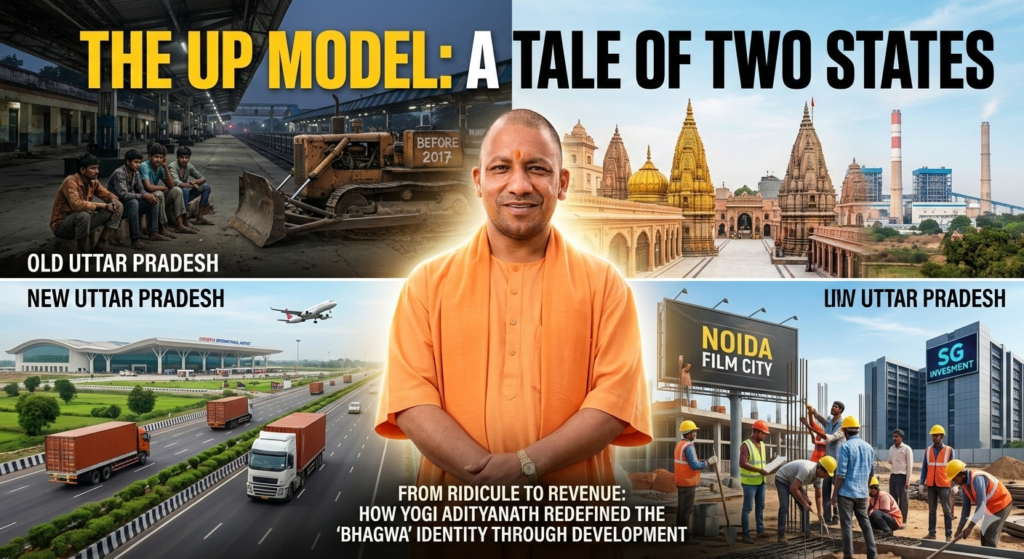
In the complex landscape of Indian politics, few figures have faced as much scrutiny over their appearance as Uttar Pradesh Chief Minister Yogi Adityanath. For years, his signature saffron (Bhagwa) robes were weaponised by critics to paint a picture of a “backward” leader unsuited for the demands of a modern economy. However, as Uttar Pradesh moves toward its ambitious $1 trillion economy goal, the narrative has shifted dramatically. Yogi Adityanath has not only retained his identity but has successfully transformed the saffron robe into a symbol of strong governance, safety, and global investment.
The Initial Narrative: Saffron as a Symbol of “Backwardness”
When Yogi Adityanath took the oath in 2017, the liberal and opposition echo chambers were rife with scepticism. Prominent leaders from parties like the Congress frequently mocked his attire, suggesting that a “Sadhu” belonged in a cave or a temple, not in a Chief Minister’s chair. The underlying message was clear: saffron was supposedly incompatible with progress, technology, and international diplomacy.
Critics argued that a leader dressed in traditional sanyasi robes would never be able to sit across global CEOs or attract foreign direct investment (FDI). This wasn’t just a critique of his clothes; it was an attempt to delegitimize a leader who wore his Sanatani identity on his sleeve.
Pillar 1: Restoring the Rule of Law
To dismantle this narrative, Yogi Adityanath didn’t change his clothes—he changed the state’s reality. He understood that no investor would put money into a state plagued by the “Bimaru” tag and mafia culture. His first priority was Law and Order.
Under his administration, the UP Police underwent a massive overhaul, recruiting over 2 lakh personnel and establishing specialized units like the Anti-Romeo Squad and forensic institutes. The “Bulldozer” became a symbol of his zero-tolerance policy against organized crime. The results were statistically undeniable:
- Dacoity dropped by 87%
- Robbery fell by 72%
- Murder cases decreased by 40%
By making the state safe, he created the foundational “belief” necessary for economic growth. Investors began to see that their capital was safer in the “New Uttar Pradesh” than ever before.
Pillar 2: Infrastructure as the State’s Lifeline
If safety was the foundation, infrastructure was the engine. Yogi Adityanath recognized that connectivity is the key to industrialization. His tenure has seen the rapid completion of the Purvanchal and Bundelkhand Expressways, with the Ganga Expressway nearing completion.
These expressways are more than just roads; they are logistics corridors that reduce travel time for goods from 12 hours to 4 hours, drastically cutting costs for manufacturers . Simultaneously, the state transitioned from being aviation-starved to an aviation hub. With the Ayodhya International Airport operational and the Jewar (Noida) International Airport set to become one of the largest cargo hubs in Asia, UP is now directly connected to global supply chains.
Global Diplomacy in Saffron: The Singapore and Japan Visits
The most potent rebuttal to the “backward” narrative came during Yogi Adityanath’s recent international tours. Clad in his saffron robes, he met with Singapore’s Prime Minister Lawrence Wong and top executives from global giants like Temasek and GIC .
In just two days in Singapore, MOUs worth approximately ₹24,335 crore were signed . These investments are slated for high-tech sectors like data centers, logistics parks, and renewable energy. Similarly, his visit to Japan brought in interest worth ₹11,000 crore in sectors ranging from auto parts to green hydrogen .
The image of a saffron-clad monk discussing semiconductor manufacturing and digital banking with global bankers has effectively “made saffron cool” in the eyes of the youth and investors alike. It proved that identity and modernity can coexist.
The Rise of the Temple Economy
Beyond factories and roads, Yogi Adityanath has pioneered the concept of the “Temple Economy.” The transformation of Ayodhya and the Kashi Vishwanath Corridor has turned religious sites into massive economic engines.
With millions of pilgrims visiting annually, the local economy—including hotels, transport, handicrafts, and small-scale vendors—has seen an unprecedented boom . The “Bhagwa” identity is now generating massive state revenue and creating millions of local jobs, turning spiritual heritage into a sustainable economic model.
The $1 Trillion Vision
In 2017, Uttar Pradesh’s economy stood at approximately ₹11 lakh crore. Today, it has surged to nearly ₹36 lakh crore—a three-fold increase in less than a decade . With over ₹4.5 lakh crore in the investment pipeline, the target of becoming a $1 trillion economy is no longer a pipe dream but a structured roadmap.
Conclusion: A New Paradigm of Governance
Yogi Adityanath has successfully destroyed the “Bhagwa CM” abuse by delivering results that speak louder than political slogans. He demonstrated that a leader does not need to adopt Western attire or shed their cultural identity to be progressive.
Today, the saffron robe stands for the “UP Model”—a blend of strict law enforcement, world-class infrastructure, and a booming investment climate. By turning his identity into a “soft power,” Yogi has not only changed the face of Uttar Pradesh but has also set a new standard for how traditional values can drive modern economic success. The world is no longer looking at the color of his clothes; they are looking at the growth of his state.