


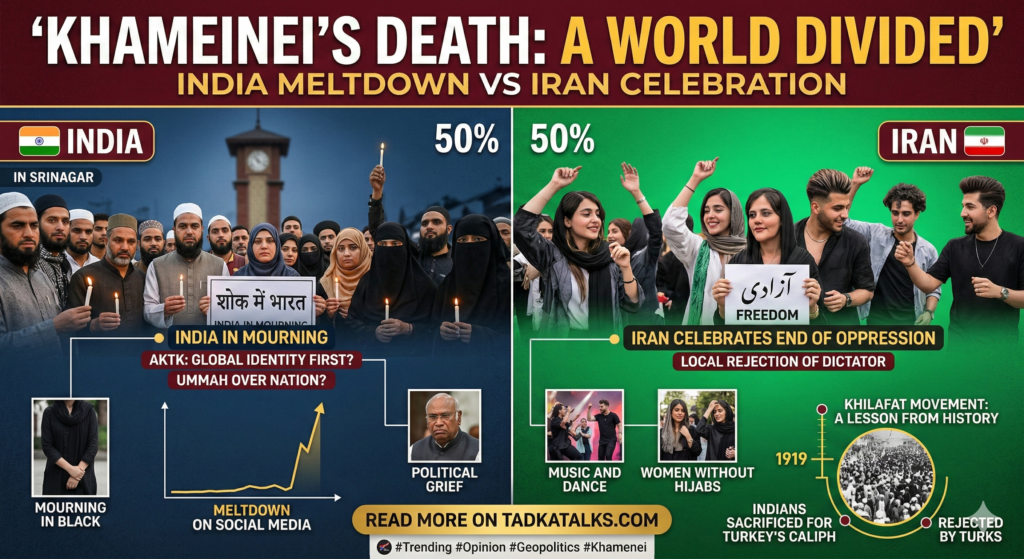
The world woke up to a seismic shift in Middle Eastern politics with the news of Iranian Supreme Leader Ali Khamenei’s death. But while the geopolitical corridors of power are busy calculating the next move, the digital and physical streets of India are witnessing a phenomenon that can only be described as a “meltdown.”
Interestingly, while several parts of India are draped in mourning, the scenes coming out of Tehran and other Iranian cities tell a completely different story—one of music, dance, and celebration. This stark contrast has sparked a heated debate: Why does the Indian “Abdul” feel more pain for a foreign leader than the people who lived under his rule?
The Great Divide: Mourning in India vs. Celebration in Iran
As news of Khamenei’s passing broke, social media feeds became a tale of two worlds. In India, cities like Lucknow, Srinagar, and Delhi saw thousands of people gathering for candle marches and protest rallies. In places like Pulwama and Bandipora, people stepped out in black clothes to express their grief, with some even calling it a personal loss, akin to losing a father figure.
However, if you look at the viral clips from Iran, the atmosphere is festive. Young Iranians were seen on rooftops playing music, women were dancing without hijabs, and fireworks lit up the sky. One Iranian woman in a viral clip famously stated, “He is dead… I feel fantastic,” highlighting a deep-rooted disconnect between the leader and his own people.
Indian Politics and the “Khamenei Effect”
The reaction wasn’t limited to the common man; it trickled up to India’s political and media circles. Figures like Mallikarjun Kharge expressed deep sorrow, a sentiment the video notes was surprisingly missing during other national tragedies like the 26/11 attacks.
Journalists and influencers like Arfa Khanum Sherwani and Rana Ayyub were seen reacting with such intensity that the video humorously refers to it as “Multiple Father Syndrome”. Even celebrities like Nora Fatehi, who were previously silent on local issues, suddenly took to social media to appeal for global peace following the news.
Understanding the ‘Ummah’ Concept: Why Global Identity Trumps National Identity
To understand why an Indian citizen would feel such a visceral connection to a leader thousands of miles away, one must look at the concept of Ummah.
The video explains that in certain religious interpretations, the “Global Muslim Brotherhood” (Ummah) is viewed as a single community where borders, passports, and constitutions take a backseat to religious identity. This sentiment is often echoed by radical clerics who suggest that if there is a conflict between the country’s law and religious tenets, the latter should prevail .
A Lesson from History: From Khilafat to Khamenei
This isn’t the first time India has seen such a mass mobilisation for a foreign religious figure. The video draws a powerful parallel to the Khilafat Movement of 1919 . Back then, Indian Muslims organised massive protests and raised funds to support the Ottoman Caliph in Turkey.
Ironically, while Indian Muslims were sacrificing their wealth and even migrating to Afghanistan in the disastrous Hijrat Movement, the people of Turkey themselves were moving toward a secular model under Mustafa Kemal Atatürk. By 1924, Turkey officially abolished the Caliphate, leaving the Indian protestors in a state of confusion and economic ruin.
The current “meltdown” over Khamenei mirrors this historical pattern: Indian supporters are more invested in the “Islamic Icon” than the very people who live in that Islamic Republic.
The Need for Introspection
The video concludes with a poignant question for Indian Muslims: Why is there such high insecurity and emotional attachment to foreign dictators when the locals themselves are seeking freedom? .
While every individual has the right to mourn, the trend of prioritising global religious identity over national concerns often leads to a disconnect from the realities of one’s own country. As the “Tadka” of this debate continues to simmer on social media, it’s a reminder that history often repeats itself—sometimes as a tragedy, and sometimes as a digital meltdown