


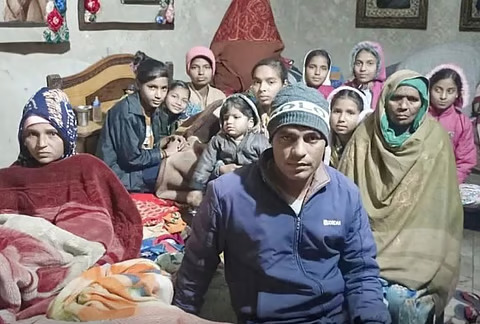
The news travelled fast, as such stories often do. A woman recently gave birth to her 11th child—a boy—after ten daughters. The reactions were predictable. Celebration. Relief. “Finally blessed.” What was missing from most conversations was discomfort. Because this isn’t just a human-interest story; it’s a mirror. And in 2026, the reflection is not flattering.
This is not about one family. It is about a mindset that refuses to retire.
Living in 2026, Thinking Like It’s 1826
We live in a world where women are redefining every imaginable boundary. Women are commanding boardrooms, leading scientific missions, rewriting sports history, and reshaping politics. Astronauts like Sunita Williams have spent extended periods in space, representing not just technological excellence but human resilience at its finest. Women’s leagues in cricket, football, and other sports are drawing global audiences. Girls from small towns are cracking international exams, winning global championships, and becoming symbols of aspiration.
And yet, in that same world, a woman’s body is still pushed through eleven pregnancies because ten daughters were not considered “complete”.
This contradiction isn’t ironic—it’s tragic.
The Son Obsession That Refuses to Die
Let’s strip away the polite language. This is not about love for a son. It is about rejection of daughters.
If the eleventh child hadn’t been a boy, would this story still be framed as “good news”? Would the applause exist? The answer is uncomfortable but obvious.
The obsession with a male heir is rooted in:
- Patriarchal inheritance norms
- Social status anxiety
- Fear of “family name ending”
- Deep-seated gender bias disguised as tradition
And the cost is almost always paid by women—physically, emotionally, and socially.
The Silent Damage No One Talks About
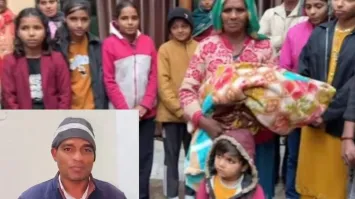
While headlines focus on the newborn boy, the real story is quieter and darker.
What about the mother?
Eleven pregnancies mean repeated physical strain, health risks, and emotional exhaustion. Choice becomes questionable when pressure replaces consent.
What about the ten daughters?
Growing up knowing that your existence was never “enough” leaves scars no empowerment slogan can heal. This is not abstract psychology; it’s lived reality for millions of girls.
When society celebrates a son after ten daughters, it sends a clear message: your value was conditional.
Women Are Not Waiting for Permission Anymore
Ironically, while families chase sons, women are already carrying nations forward.
Across the globe:
- Women scientists are leading climate research
- Women athletes are breaking records once thought unreachable
- Women entrepreneurs are building billion-dollar enterprises
- Women educators are transforming entire communities
Progress is not coming from sons alone. It never did. The world runs on competence, not chromosomes.
A Complicated Chapter: Women-Centric Campaigns
Gurmeet Ram Rahim has documented history of large-scale women-focused initiatives run through institutions associated with his organisation.
Over the years, more than 20 campaigns were launched focusing on:
- Girls’ education
- Women’s participation in sports
- Skill development and self-reliance
- Cultural and artistic platforms for young women
Schools linked to these initiatives have produced female students who went on to represent India in national and international sports competitions, including world-level championships. For many girls from marginalized backgrounds, these platforms provided their first access to structured education, training, and visibility.
Acknowledging this does not erase the crimes, nor does it absolve accountability. But it highlights an uncomfortable truth: women’s empowerment efforts often coexist with flawed human leadership. Progress sometimes comes from imperfect sources, and society must learn to separate outcomes from individuals—without excusing wrongdoing.
Why This Context Matters
The story of the 11th child is not isolated. It exists in parallel with:
- Women flying spacecraft
- Girls winning world titles
- Campaigns pushing female participation in every field
This tells us one thing clearly: the problem is not women’s capability—it is society’s perception.
We have evidence everywhere that daughters uplift families, communities, and nations. Still, families chase sons as if progress hasn’t already knocked on their door.
Tradition vs Trauma
Defenders often hide behind words like “culture” and “tradition.” But traditions that demand repeated childbirth until a son is born are not heritage—they are harm.
Culture should protect people, not exhaust them.
Tradition should evolve, not suffocate.
If a belief system requires a woman to risk her life eleven times, it deserves questioning—not respect.
The Editorial Bottom Line
The real tragedy is not that a boy was born after ten daughters.
The tragedy is that ten daughters were never enough.
Until a girl child is welcomed without conditions, without comparisons, and without expectations of replacement, no amount of moon landings or world cups can claim true progress.
Women are already proving themselves—in space, in sports, in science, in classrooms, and in communities.
The only thing left behind is society’s mindset.
And that, more than anything, needs urgent evolution.