


1. Introduction: The End of a Thirty-Year Monopoly
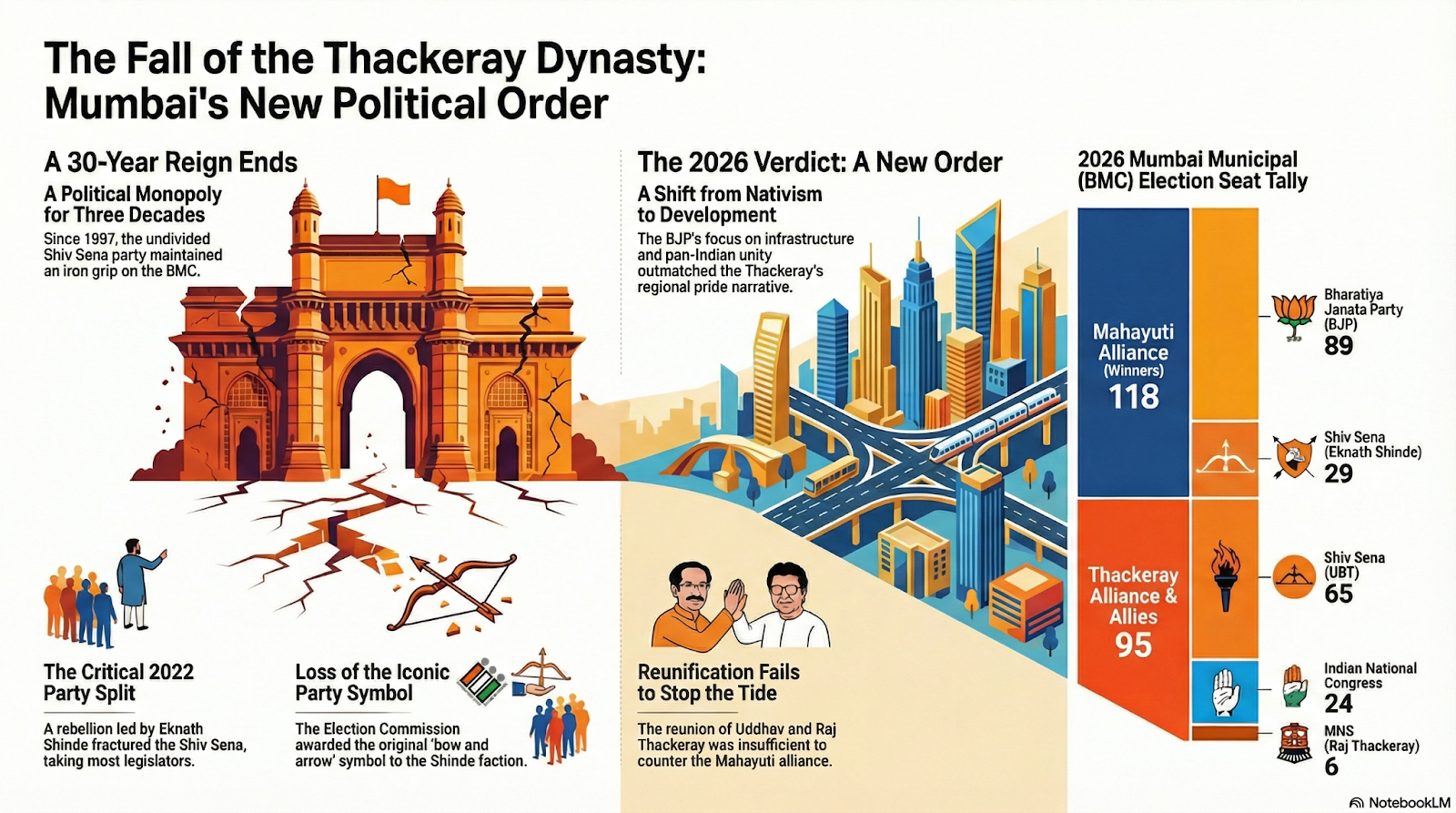
The January 15, 2026, Brihanmumbai Municipal Corporation (BMC) election was not merely a civic exercise; it was the final stage of a long-gestating structural decay. With a voter turnout of 52.94%, the electorate participated in the systematic dismantling of a political dynasty that had held an iron grip on the city since its 1997 baseline dominance of 103 seats.
For three decades, the Thackeray name was synonymous with the city’s administrative soul. However, the 2026 results represent a total reconfiguration of power. The Mahayuti alliance, a coalition of the BJP and the Eknath Shinde-led Shiv Sena, secured 118 seats, crossing the majority mark and relegating the Thackeray brothers to the periphery. This shift marks the transition from a model of nativist regionalism to a technocratic, developmental framework—a “seismic event” for a city where the ₹75,000 crore stakes define the very nature of political survival.
2. The ₹74,427 Crore “Resource Engine” Has Changed Hands
The loss of the BMC is, fundamentally, an institutional entropy for the Thackeray legacy. The corporation’s 2025–26 budget of ₹74,427 crore is more than a fiscal document; it is a patronage scaffolding that once fueled the entire Shiv Sena ecosystem.
Historically, the Shakha (branch) network operated as a shadow government, providing local mediation and services that the official state machinery often missed. This “Resource Engine” allowed the party to maintain a cadre that was financially and socially beholden to the family. With the Mahayuti now controlling the standing committees, this engine has been severed. The financial catastrophe is compounded by the sheer scale of the loss; the BMC’s budget is so massive that it exceeds the individual budgets of seven smaller Indian states.
The BMC is the wealthiest municipal body in Asia. Controlling it grants the ruling party immense financial muscle, allowing it to move beyond mere governance into the realm of direct narrative control through massive civic contracts and grassroots patronage.
3. The Real Estate Exodus: Why Demographics Trumps Identity
A primary driver of this earthquake is “demographic arbitrage.” For decades, the Thackeray base resided in the industrial heartlands of Parel, Dadar, and Lalbaug. However, escalating real estate prices have triggered a “Real Estate Exodus,” pushing traditional Marathi-speaking families out of the city core and into the wider Mumbai Metropolitan Region (MMR) towns like Thane and Kalyan-Dombivli.
In their place, a cosmopolitan mix of aspirational voters has emerged. These voters prioritized the Mahayuti’s technocratic pivot—projects like the Mumbai Coastal Road and Metro expansion—over the “Sons of the Soil” rhetoric. Even the highly anticipated “Thackeray-Thackeray reunion,” which saw Uddhav and Raj join forces after 20 years to “protect” Mumbai, failed to resonate. The rejection of this brand was most visible in the record-low performance of the MNS:
- Mumbai (BMC): A record low of 6 seats, losing its pulse in traditional heartlands.
- Pune & Thane: A total wipeout with 0 seats, as voters preferred the “double-engine” growth model.
- Nashik: Minimal presence, failing to recapture the relevance of its 2012 peak.
Even Raj Thackeray’s use of high-tech audio-visual mediums to attack the “East India Company-style spread” of the Adani Factor failed to move a pragmatic electorate that viewed development as the only viable currency.
4. The “Marathi Mayor” Gambit: Neutralizing Nativism
The BJP and Eknath Shinde executed a tactical masterstroke designed to solve the “identity vs. development” paradox. By promising a “Marathi Mayor” under a Mahayuti victory, the alliance neutralized the UBT’s primary weapon: the accusation of “anti-Marathi” bias.
This maneuver allowed the BJP to court the cosmopolitan voter with promises of global infrastructure while simultaneously offering a traditional “Marathi face” for the city’s highest ceremonial post. It was a bridge between identity politics and urban aspiration, effectively ending the Shiv Sena (UBT)’s monopoly on the Marathi narrative and showing that identity can be co-opted by technocratic forces.
5. The Annamalai Error: The High Cost of Regional Ridicule
A significant psychological misstep by the Thackeray faction was the ridicule directed at national figures like C. Annamalai. This “provincial tunnel vision” backfired spectacularly in a city as globalized as Mumbai.
By dismissing such figures as “outsiders,” the campaign alienated the very demographics that now define the city’s swing wards. The attacks were felt personally by the South Indian IT professional in Andheri and the Gujarati businessman in Malabar Hill, who viewed the rhetoric as a regression to the exclusionary politics of the 1960s. This miscalculation signaled a strategic anxiety within the Thackeray camp, reinforcing an “outdated” brand image that failed to grasp the city’s modern, pan-Indian reality.
In a hyper-connected metropolitan electorate, national perception often dictates local outcomes. Ridiculing a figure who symbolizes national growth signaled to Mumbai’s diverse electorate that the Thackeray brand was stuck in a narrow, regionalist loop.
6. The “Vote Cutter” Effect: A Fractured Opposition
The 2026 results were heavily influenced by “strategic disruption.” The loss of the original “Bow and Arrow” symbol fundamentally disrupted brand recognition among older, less tech-savvy segments, who struggled to identify the new “Mashaal” (Torch) symbol. This political sclerosis was exploited by parties like the AIMIM, which won 8 seats by targeting minority and Dalit pockets.
Strategic Impact Highlights:
- H/West (Bandra): AIMIM acting as a “vote cutter,” capturing minority allegiances that were once the bedrock of the MVA.
- Malad West (Ward 46): A BJP landslide, illustrating the total displacement of UBT and MNS influence in diverse, newly gentrified neighborhoods.
- Santacruz (Ward 90): A marginal INC win that highlighted the fragility of the opposition coalition when faced with fragmented vote shares.
- Byculla (Ward 184): One of the few core enclaves where the UBT managed to stave off the AIMIM challenge.
7. Conclusion: Beyond the Roar
The 2026 BMC election signals more than a change in leadership; it suggests a permanent shift in the political order. The “Tigers” now face an existential crisis, stripped of the financial scaffolding and municipal patronage that sustained them for three decades.
As Mumbai continues its transition into a technocratic, globalized hub, the failure of the Thackeray reunion suggests that legacy alone is no longer a viable political currency. The era of the regional monopoly is dead. The question that remains is whether identity politics can ever regain its footing, or if the roar of the Tiger has finally been silenced by the hum of a more efficient, developer-driven city.