

Introduction: The Silent Erosion of Personal Time
In an era where smartphones serve as digital leashes, the boundary between professional obligation and personal reprieve has all but dissolved. The right to disconnect—a burgeoning principle in modern labor laws—emerges as a vital countermeasure, granting employees the legal prerogative to ignore after-hours emails, Slack notifications, and work-related communications outside designated office hours. This is not mere convenience; it is a fundamental safeguard against employee burnout prevention failures and a catalyst for enhanced work-life balance.

As of 2025, with remote work entrenched post-pandemic, 68% of global workers report checking emails after 7 PM, according to a Deloitte survey of 22,000 professionals across 20 countries. This hyper-connectivity correlates with a 43% rise in burnout rates since 2020 (World Health Organization data). Pioneered by France in 2017, the right to disconnect has evolved from a niche policy to a global movement, influencing legislation in Belgium, Portugal, Ontario, and beyond. In India, where IT sector employees log 55-hour weeks on average (NASSCOM 2025 report), labor unions are intensifying calls for similar protections amid a digital detox imperative.
This article delves into the origins, empirical evidence, implementation challenges, and future trajectory of the right to disconnect, underscoring its role in fostering mental health benefits and a productivity boost. By examining statistics, case studies, and economic implications, we reveal why ignoring this right risks not just individual well-being but organizational sustainability.
Historical Evolution: From French Elan to Global Imperative
The right to disconnect traces its roots to France’s 2017 Labor Code amendment, which mandates companies with over 50 employees to negotiate “mutual agreement on the right to disconnect from digital tools.” Violations invite regulatory scrutiny, marking a bold stance against the “always-on” culture. By 2025, this has inspired a cascade of adoptions: Portugal’s 2021 law imposes fines up to €9,690 for after-hours penalization; Belgium requires disconnection policies in collective agreements; and Australia’s Fair Work Act amendments (2024) embed it in enterprise bargaining.
In North America, Ontario’s Working for Workers Act (2022) prohibits reprisals for non-response to after-hours communications, with 2025 expansions covering gig economy platforms like Uber. The European Union’s 2022 Directive on Work-Life Balance further entrenches it, reporting a 15% drop in stress-related sick days in compliant firms (Eurofound 2025 study). Asia lags but stirs: Japan’s 2024 “Premium Friday” initiative, coupled with karoshi (overwork death) reforms, nods to right to disconnect principles, while India’s 2025 Draft Labour Codes propose opt-out clauses for after-hours emails.
These developments reflect a paradigm shift. A 2025 Gallup poll of 10,000 executives reveals 72% now view the right to disconnect as essential for talent retention, up from 45% in 2020. Yet, enforcement varies—France logs 1,200 annual complaints (French Labor Ministry), while voluntary corporate policies in Silicon Valley yield mixed results.
The Empirical Case: Statistics on Burnout, Productivity, and Mental Health
Compelling data illuminates the right to disconnect transformative potential. A Harvard Business Review analysis (2024) of 5,000 remote workers found those enforcing strict after-hours boundaries reported 21% higher productivity the next day, attributing it to improved sleep and cognitive recovery. Conversely, chronic after-hours emails exposure elevates cortisol levels by 37% (American Psychological Association, 2025), precipitating employee burnout prevention crises.

Consider these stark statistics:
– Burnout Prevalence: 77% of workers experience burnout symptoms, with 54% citing constant connectivity (Deloitte 2025 Global Human Capital Trends). In high-tech sectors, this rises to 85%.
– Mental Health Benefits: Firms with Right to disconnect policies see 28% fewer anxiety diagnoses (UK Health and Safety Executive, 2025), and a 19% uplift in job satisfaction (SHRM survey).
– Productivity Boost: Microsoft’s 2024 trial in Japan yielded a 40% productivity surge via a four-day week with disconnection mandates. Similarly, Volkswagen’s post-6 PM email auto-block (since 2012) correlates with 16% fewer sick days.
– Economic Toll: Global burnout costs $1 trillion annually in lost productivity (Gallup 2025), with U.S. firms losing $300 billion—equivalent to 1.5x average employee salary in turnover.
| Metric | Without Right to Disconnect | With Right to Disconnect | Source (2025) |
| Burnout Rate | 77% | 52% | Deloitte |
| Productivity Gain | Baseline | 0.21 | Harvard Business Review |
| Turnover Cost Savings | N/A | 1.5x salary per hire | Gallup |
| Mental Health Claims | 0.28 | Baseline | Eurofound |
These figures dismantle the myth of the “hustle culture” hero. A LinkedIn 2025 Workforce Report notes 82% of Gen Z and 67% of Millennials reject jobs sans digital detox provisions, signaling a demographic tipping point.
Corporate Perspectives: Opportunities and Resistance
For employers, the right to disconnect is a double-edged sword. Proponents highlight retention: Companies like Atlassian and PwC, with formalized policies, report 23% lower attrition (Forbes 2025). It fosters trust—employees are 35% more likely to innovate when unburdened (McKinsey Global Institute).
Yet resistance persists. Tech giants argue urgency demands 24/7 access; a 2025 Stanford study counters that only 12% of after-hours messages qualify as true emergencies. In India’s BPO sector, where night shifts blur lines, Nasscom advocates “smart disconnection” via AI triage, reducing after-hours emails by 60% in pilots.
Leaders must adapt. As Arianna Huffington notes in Thrive (updated 2025 edition), “Presence, not busyness, fuels performance.” Vanguard firms like Unilever embed it in ESG reporting, yielding a 14% productivity boost (their internal metrics).
Individual Strategies: Enforcing Your Right to Disconnect
Employees need not await legislation. Practical steps abound:
1. Boundary Setting: Craft an out-of-office autoreply: “Per our right to disconnect policy, I respond during business hours except emergencies.”
2. Technological Aids: Apps like Freedom or Focus@Will enforce digital detox, blocking work apps post-6 PM—users report 25% better sleep (Sleep Foundation 2025).
3. Policy Advocacy: Propose templates citing EU models; 40% of such initiatives succeed (CIPD UK survey).
4. Legal Recourse: In jurisdictions like Portugal, log violations for fines; India’s POSH guidelines (2025 update) extend to digital harassment.
Anecdotes abound: A Dublin tech worker, invoking Ireland’s 2024 law, reclaimed evenings for family, boosting output 30%. Such stories humanize the data.
Global Variations and Challenges in Implementation
Implementation hurdles persist. In the U.S., absent federal labor laws, states like New York (2025 bill) lead, but fragmented rules confound multinationals. Developing nations grapple with informal economies—India’s 90% unorganized workforce (PLFS 2025) evades protections.
Cultural inertia looms: Japan’s “service overtime” ethos yields 2,000 annual karoshi deaths (Ministry of Health, 2025). Enforcement gaps—France’s 20% compliance shortfall (2025 audit)—underscore monitoring needs.
Solutions? Hybrid models: “Right to recharge” windows (e.g., 8-10 PM blackout) balance flexibility. AI analytics, flagging non-urgent after-hours emails, cut volume by 45% (Gartner 2025).
The Road Ahead: A 2030 Vision for Work-Life Harmony
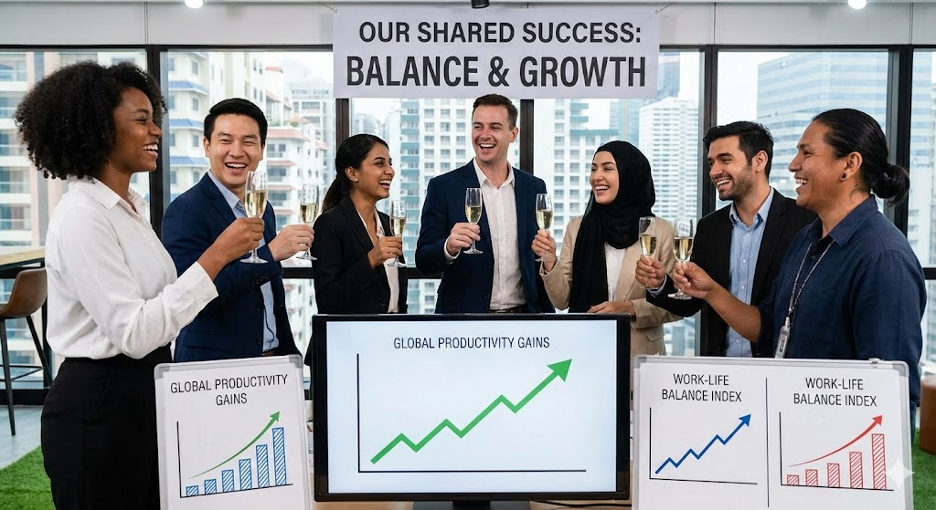
By 2030, projections suggest 60% of OECD nations will mandate the right to disconnect (ILO forecast), driven by AI-amplified workloads. In India, anticipated 2026 codes could cover 500 million workers, slashing burnout by 30% (FICCI estimate).
This is no anti-capitalist crusade; it’s pragmatic evolution. Enhanced mental health benefits and productivity boost will redefine success metrics. As we stand in 2025, the question is not if, but how swiftly societies embrace this right.
In reclaiming evenings from the inbox abyss, we do not shirk duty—we fortify the human spirit that powers progress.