


Introduction: Beyond the Viral Memes
If you scroll through social media today, you have likely encountered the viral clips. A man in a suit shouts “Hallelujah,” and a woman on stage begins to convulse; a pastor claims to speak to God on a mobile phone; a “dead” person suddenly sits up. For the internet generation, these videos are meme material—content to be laughed at and scrolled past,. But if you pause the laughter and zoom into the map of India, specifically the border districts of Punjab, these videos reveal a socio-political transformation that is anything but funny.
What appears to be a circus of superstition on screen is, in reality, a manifestation of a deep systemic failure in one of India’s most culturally proud states. Ground reports and statistical estimates suggest that Punjab is witnessing a wave of religious conversion so massive that in some border villages, the demographic makeup has flipped entirely. This is not just about faith; it is about economics, caste discrimination, foreign funding, and the desperate aspirational fatigue of a state that has lost its way.
The Data: What the Census Hides
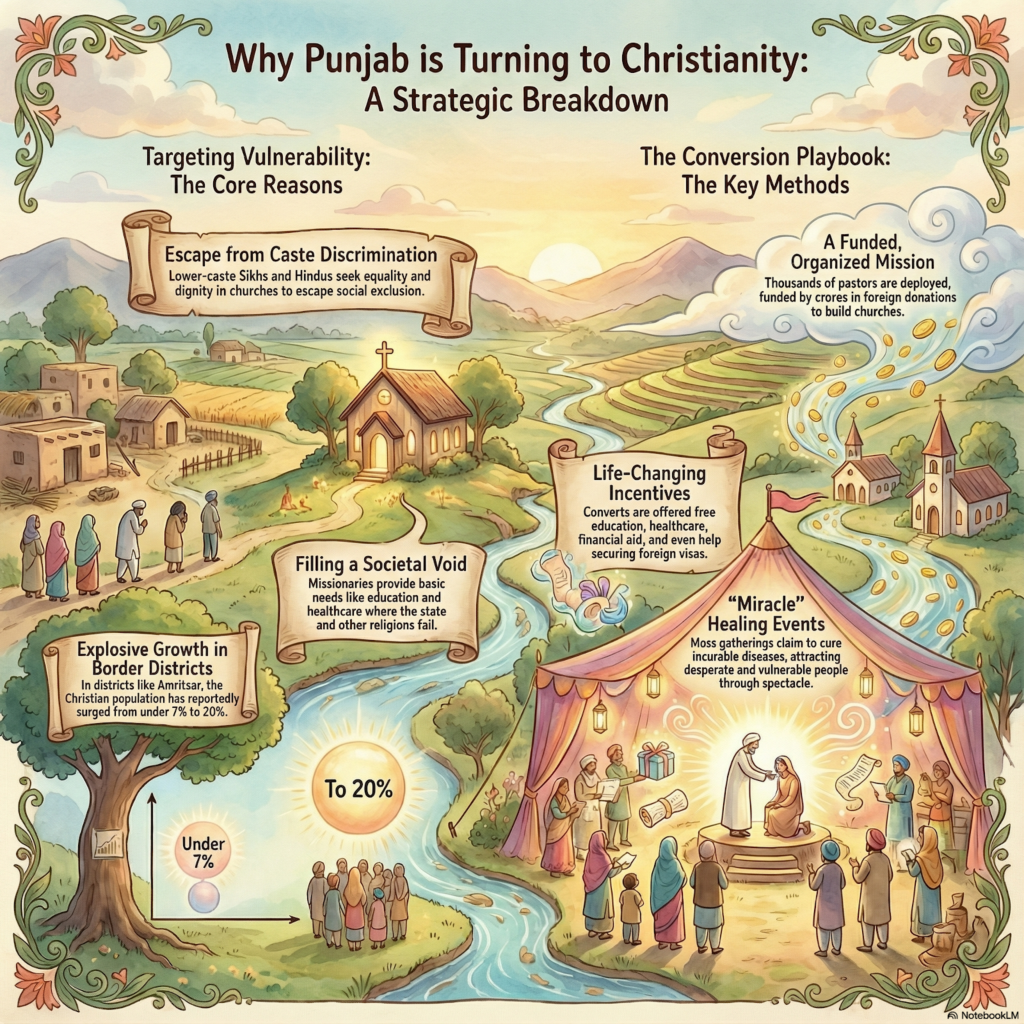
To understand the scale of the issue, we must look beyond the official data, which often lags behind reality. According to the 2011 Census, the Christian population in districts like Amritsar and Gurdaspur was merely 2% to 7%,. However, current ground estimates present a radically different picture. In these very districts, the Christian population is now estimated to be between 18% to 20%.
The growth is not organic; it is explosive. In the border district of Tarn Taran, reports indicate a staggering 102% increase in the Christian population between 2011 and 2021. In specific villages like Kang Sabu, nearly 70% of the residents have converted. In other villages like Dujowal, just 2 kilometres from the Pakistan border, the Sarpanch claims 30% of the village has turned to Christianity.
These numbers are often underreported because many converts are “Crypto-Christians.” They adopt the new faith for its perceived benefits but do not change their names or their official religion in government records to preserve their reservation benefits and social standing,. They are the “Pagg wale Christians” (Christians with Turbans), a new demographic that blends Sikh identity with Christian theology.
The Root Cause: The Market of Helplessness
Why is this happening? Why would a state, the birthplace of Sikhism—a religion founded on the principles of sacrifice and equality—see its people turning away in droves? To understand this, we must dissect the “Market of Majboori” (Helplessness).
1. The Sting of Caste Discrimination The harsh truth is that the majority of converts in Punjab come from the Mazhabi Sikh and Valmiki Hindu communities—the Dalits of the region,. Sikhism, in its essence, preaches castelessness. However, societal reality often contradicts religious theory. In many Punjabi villages, discrimination is so entrenched that Mazhabi Sikhs have separate Gurdwaras because they are not welcomed in the main ones,.
When a missionary opens a church and invites these marginalized communities to sit together, eat together, and pray together, it offers something they have been denied for generations: Dignity. The church becomes a place where they are not “lower caste” but simply “believers.” This social acceptance is a powerful drug for a community that has faced historical exclusion.
2. The Broken Education and Health Systems The state has failed to provide quality affordable education and healthcare, and missionaries have stepped in to fill the vacuum. Convent schools in India are viewed as a ticket to the elite class. In districts like Gurdaspur and Amritsar, missionaries run schools that offer high-quality English education—a dream for any poor parent—at heavily subsidized rates or entirely for free.
A school in Fatehgarh Churian, for instance, spends ₹90 lakh annually to educate poor children for free. For a daily wager, the choice is brutal but simple: keep your religion and let your child remain illiterate, or convert and give your child an English education. When basic survival and a child’s future are at stake, religious dogma takes a backseat. As the saying goes, “A hungry stomach has no religion.”
Similarly, mission hospitals offer free or cheap treatment. In a country where a single medical emergency can push a family into poverty, the promise of free surgery in exchange for prayer or conversion is a trade many are willing to make,.
The Modus Operandi: Miracles, Visas, and Strategy
The conversion machinery in Punjab is not operating on 19th-century tactics; it has evolved into a sophisticated, 21st-century corporate operation.
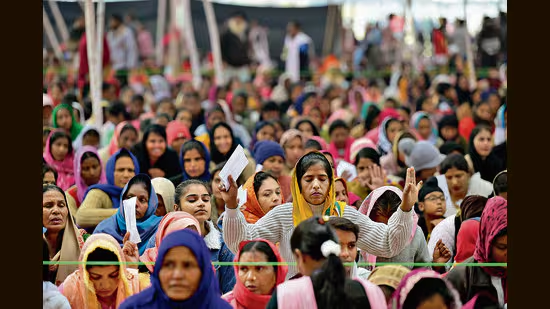
1. The “Changai Sabha” and the Miracle Industry The most visible aspect of this movement is the “Changai Sabha” (Healing Meeting). Pastors have turned spirituality into a spectacle. They claim to cure incurable diseases—cancer, blindness, paralysis—within minutes,. Posters across Punjab advertise these meetings with claims of raising the dead.
These events are highly organized. They are live-streamed to millions on YouTube, generating revenue and global attention. To gather crowds, they use “Crowd Pulling” strategies, often inviting Bollywood celebrities like Sunil Shetty, Prem Chopra, and others to attend Christmas events, lending a veneer of legitimacy and glamour to the proceedings.
2. The “Visa” Trap Punjab is a state obsessed with the “Canadian Dream.” Since 1991, lakhs of Punjabis have migrated abroad, and millions more aspire to. Pastors have weaponized this desperation. Testimonies in churches frequently feature individuals claiming, “I prayed to Jesus, and my visa arrived in 10 days”.
It sounds absurd to the rational mind, but for a desperate youth facing unemployment, the Church presents itself as a spiritual embassy that can clear immigration hurdles. Even police personnel have been filmed asking pastors to pray for their children’s US visas.
3. Cultural Assimilation Unlike the colonial era, today’s missionaries do not ask converts to abandon their culture. They have “Indigenized” the faith. You will hear Christian hymns sung to the tunes of traditional Punjabi Tappe and Boliyan. The pastors wear turbans; the language is Punjabi; the style is Desi. This strategy, known as “Soft Influence,” lowers the barrier to entry. It makes the foreign faith feel native and familiar,.
The Dark Side: Scams and Exploitation
While some conversions are driven by genuine aid or faith, a significant portion of this industry is built on fraud and exploitation of the vulnerable.
1. The “Heavenly Real Estate” Scam The manipulation has reached levels that can only be described as criminal. There are documented cases where pastors have convinced elderly women to “buy plots in heaven.” They are told to pay money to register a plot in the afterlife, then pay more to build walls, and finally, pay for the roof. This is not religion; this is a financial scam preying on the fears of the elderly.
2. The Cost of “Free” Prayer While the entry to the Sabha might be free, the “special prayers” are often not. Investigations have revealed that pastors charge anywhere from ₹80,000 to several lakhs for “healing prayers” for serious illnesses.
A heartbreaking example involves a family in Jalandhar whose daughter had cancer. The church allegedly told them to stop medical treatment, destroy their “idols,” and pay for prayers. The family complied, desperate for a miracle. The daughter died. When they returned to the pastor, he reportedly dismissed them, saying his “supply” of power was gone or that their faith was insufficient.
3. Medical Negligence This blind faith is life-threatening. People with treatable conditions are often told to rely solely on prayer. When the “miracle” is faked on stage—often using paid actors or temporary adrenaline rushes—the real patients in the audience stop their medication, leading to fatal consequences.
The Funding Nexus: The Foreign Hand
Running thousands of churches, free schools, and mega-events requires massive capital. Where is this money coming from?
Reports suggest a massive influx of foreign funds, often routed through NGOs. While India has the Foreign Contribution (Regulation) Act (FCRA) to monitor donations, loopholes exist. Money is often sent as “donations” for social work but is utilized for religious expansion. It is estimated that thousands of crores are pumped into India annually from countries like the US, UK, and Canada to support these missionary activities. This funding allows pastors to offer financial incentives—monthly rations, house repairs, or cash handouts—that local religious institutions struggle to match.
The Political Silence
Despite the scale of these conversions and the allegations of fraud, the political response has been muted. Why? Vote Bank Politics. The growing Christian population in Punjab is now a significant voting bloc. They have formed their own political entities, like the United Punjab Party (UPP).
Politicians, fearing the loss of votes, engage in appeasement. High-profile pastors like Bajinder Singh are seen with police protection, signaling their political clout. When a pastor openly declares, “Sikhism is a small religion,” and faces no political backlash, it highlights how the demographic shift has already altered the power dynamics of the state.
The Solution: A Call for Introspection
Banning conversions is often touted as the solution, and while laws against forceful conversion exist, they are merely band-aids. You cannot ban a person from seeking a better life or more dignity. If we want to address the issue, we must look at the mirror, not just the missionary.
1. Religious Reform and Social Dignity The leaders of Sikhism and Hinduism must ask themselves: Why are their own people leaving? If a Mazhabi Sikh feels more welcome in a church than in a Gurdwara, that is a failure of the community, not the success of the pastor. Religious institutions must actively work to dismantle caste barriers and ensure that “equality” is practiced, not just preached.
2. The Role of the State The state government cannot abdicate its responsibility. If the government provided high-quality schools and hospitals, the allure of the “convent school” or the “mission hospital” would vanish. The “Rice Bag” convert is a product of state failure. If a person has to change their God to get a bag of rice, the shame lies with the government that let them go hungry,.
3. Cracking Down on Fraud There is a fine line between faith and fraud. The government must treat “miracle cures” for cancer and “selling plots in heaven” not as religious activities but as consumer fraud and medical negligence. The law must protect the gullible from financial and physical harm, regardless of the religion of the perpetrator.
Conclusion: The Future of Punjab
Punjab is standing at a precipice. The current wave of conversions is a symptom of a society that is fracturing along lines of caste and class, fueled by desperation and funded by external interests.
If the current trends continue, the cultural and demographic identity of Punjab will undergo an irreversible change. The solution is not violence or hatred; it is reform and empowerment. We must build a society where a Dalit does not need to convert to be treated with dignity, where a poor father does not need to change his faith to educate his child, and where the sick do not need to buy “healing” from a scammer because they cannot afford a doctor.
Until we fix the broken floor of our own house, we cannot blame the neighbor for offering shelter to those who are falling through the cracks.