


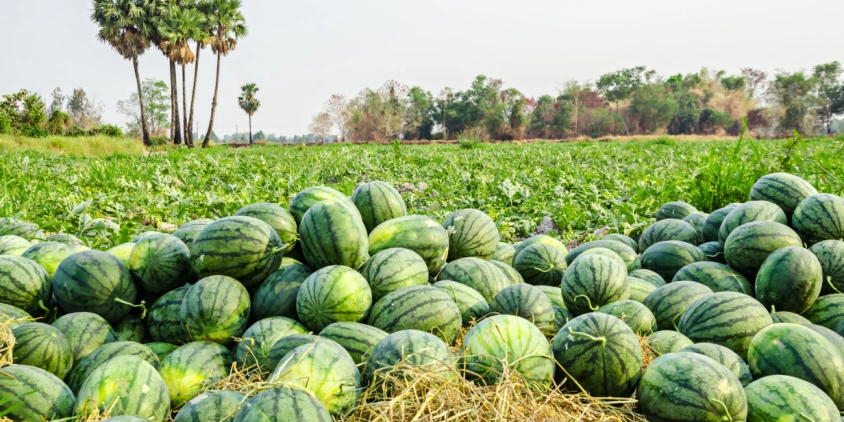
India | Sowing Period: 1 January – 28 February
Major Growing States: Andhra Pradesh, Karnataka, West Bengal, Rajasthan, Odisha, Tamil Nadu
Watermelon is one of the most popular summer fruit crops grown across India for both fresh consumption and commercial markets. The crop performs best in regions with long, warm, frost-free periods, making it ideally suited to many Indian states during the winter–summer transition period.
Asia contributes nearly three-fourths of global watermelon production, with China leading worldwide output. In India, watermelon cultivation is expanding rapidly due to high demand, good market prices, and suitability for long-distance transportation.
Basic Information
- Common Name: Watermelon
- Botanical Name: Citrullus lanatus
- Family: Cucurbitaceae
- Origin: Tropical Africa
Watermelon is a climatic vegetable crop rich in minerals such as zinc, manganese, magnesium, and phosphorus. It contains very low levels of sodium and cholesterol, making it nutritionally beneficial. The crop is also suitable for long-distance transport due to its firm rind.
Climate Requirement
Watermelon is a warm-season crop and grows best in tropical and sub-tropical climates.
- Requires abundant sunlight
- Dry weather and long day conditions favour growth
- Excess humidity increases the risk of pests and diseases
Temperature requirements:
- Germination: minimum 20°C
- Early vegetative growth: 25–30°C
- Fruit development: 30–35°C
Soil Requirement
- Best suited soil: Sandy or sandy loam
- Soil must be fertile and well-drained
- Poor drainage leads to root diseases
- Ideal soil pH: 6.0–7.0
Season of Cultivation
- North India: February to March
- Western India: Winter season
- Dry season is ideal for watermelon cultivation
- Extreme heat combined with high humidity should be avoided
Land Preparation
- Prepare the field to obtain fine tilth
- Remove weeds and previous crop residues
- Apply 25 tonnes of well-decomposed FYM per hectare during land preparation
Seeds are generally directly sown, though nursery raising or greenhouse sowing can be adopted in frost-prone regions.
Seed Rate and Sowing
- Seed rate: 3.5–5.0 kg per hectare
Spacing Methods
| Method | Spacing |
|---|---|
| Furrow method | 2–3 m |
| Pit method | 2–3.5 m |
| Hill method | 1–1.5 m |
Proper spacing ensures good vine spread and adequate sunlight interception.
Fertilizer Requirement
| Nutrient | Quantity |
|---|---|
| Nitrogen | 100 kg/ha |
| Phosphorus | 60 kg/ha |
| Potassium | 60 kg/ha |
Balanced nutrient application improves fruit size, sweetness, and overall yield.
Irrigation Management
- Watermelon has deep tap roots, reducing the need for frequent irrigation
- Irrigate at 10–14 day intervals
- Avoid excessive watering to prevent fruit cracking
- Evening and night irrigation should be avoided to reduce foliar diseases
Popular Watermelon Varieties
Sugar Baby
- Fruit weight: 3–5 kg
- Deep pink flesh
- Small seeds
Improved Shipper
- Dark green rind
- Large fruit size
- Moderate sweetness
Special No. 1
- Early maturing variety
- Red flesh
- Small-sized fruits
Arka Manik
- Very sweet taste
- Deep red flesh
- Oval-shaped fruits
Harvesting
- Harvesting is done 95–120 days after sowing
- Fruits are harvested at full maturity
- Rind becomes hard and cannot be scratched with a thumbnail
Yield
- Average yield: 150–220 quintals per hectare
- Yield varies depending on variety, climate, and crop management practices
Storage
- Pre-cool fruits at 12–15°C within 24 hours after harvest
- Watermelon can be stored for up to two weeks at 7°C with suitable humidity
- Long storage may reduce crispiness and colour
Conclusion
Watermelon cultivation is a profitable and rewarding crop when grown under suitable climatic conditions. By following recommended sowing time, spacing, nutrient management, and irrigation practices, farmers can achieve high yields and better fruit quality.